Showing posts with label Women. Show all posts

Wednesday, 3 December 2014

Women’s Autonomy and Demography: Women pay the price for population control

Prevelance of female sterilisation over male sterilisation

India is one of the first countries in the world to have formulated family planning programmes. Family planning programmes like mass sterilisation in India were introduced in response to the booming population . However it is female sterilisation (tubectomy) which has always been prevalent over male sterilisation (vasectomy) or other contraceptive methods.

Recently, in one of the worst medical disasters in India’s history, many women lost their lives in a mass sterilisation camp organised in Chhattisgarh. Family members of the victims have reported how women were pressurised to undergo sterilisation. Mahesh, brother-in-law of one casualty, told the Indian Express newspaper, “They [health workers] said nothing would happen, it was a minor operation. They herded them like cattle.”

However, this is not one of the rare cases where mass sterilisation camp has killed women. Between 2003 and 2012, as estimated by various reports, thousands of women died in sterilisation camps organised in various states including Uttar Pradesh, Tamil Nadu, Maharashtra, Karnataka and Andhra Pradesh.

Violating all medical guidelines, sterilisation camps like the one in Chhattisgarh and others are often found to have used contaminated medicines, rusted surgical equipments and unhygienic environment. Guidelines which set the maximum limit of surgeries to 30 a day, have often been ignored by doctors in sterilisation camps, were the operations outnumber the limit. The cause of such tragedies can be related to sheer medical negligence, apathy of doctors towards patients, poor state of health services in India and above all violation of women’s rights over their bodies.

The District Level Household and Facility Survey (DLHS)  in 2007–08 revealed that over 35 per cent of married women in  the the reproductive age group ( 15–49 years) had undergone tubectomy, as against 1 per cent of men who have undergone vasectomy. This is despite the fact that Tubectomy as an irreversible method of birth control is a more complex procedure than vasectomy.

In this light, it is important to comprehend the relationship between family planning in India and female sterilisation.

No choice for women: Social pressure, national targets

The DLHS data in 2012-13 have also indicated State Governments preference on female sterilisation over other contraceptive methods in India’s family planning programmes. For example, in Andhra Pradesh, during 2007-2008 and 2002-2013, 60 and 63 per cent women in the fertile age range had been operated respectively. However, during the same period, the number of men who underwent sterilisation, came down from 4 to 2 per cent. A similar trend was observed across many states in India.

This trend can be traced to the deep rooted social belief that the primary role of women is that of  reproduction and child rearing. Instead of looking at family planning as a responsibility of both men and women, family planning programmes in India have been directed at women by and large.  Added to this there is a tremendous social stigma attached to male sterilisation. Along with the fear of impotency, physical weakness, “it becomes a question of manhood”, says Rukmini, a District Reproductive and Child Health (RCH) Officer from Karnataka. “Unfortunately social stigma nearly always ensures the fairer sex is the subjugated lot…………….where women are more likely to go under the knife rather than men.”
(The Hindu)

In a patriarchal society, women usually have little autonomy within and outside the household; they also have limited control and no voice over their own reproductive and contraceptive choices. Hence they are always made easy targets of family planning programmes. For most women, sterilisation is not a choice, it is a diktat. Thus women are forced to undergo sterilisation, sometimes without their knowledge or opportunity to provide consent. According to the DHLS 2007-08, 40 per cent of women who got operated across India were illiterate. When women are poor and uneducated, they are more vulnerable, and are easily persuaded to accept the painful and irreversible contraceptive method through financial or other incentives. They are forced to undergo sterilisation either by authorities responsible for family planning programmes or by family members who are in need of monetary benefits. Women are convinced to undergo surgeries by luring them with cash incentives. “The husband of a Baiga tribe woman who died after undergoing tubectomy at a government-organised sterilisation camp in Bilaspur district alleged that health workers put pressure on them and also held out a promise of money for consenting to the operation.” (India Today) This is nothing but grave violation of women’s rights.

In 2012-13, the District Level Household and Facility Survey highlighted poor quality family planning services which were offered to women. Women were not informed about the side-effects of sterilisation or about other methods of contraception. Even where women were counseled, the staff strategically refrained from giving adequate and correct information. For example, in Maharashtra, only 17 per cent of the women were told about the side-effects, while in Punjab and Haryana only 14 per cent and 11 per cent women respectively were given any information related to other methods of contraception. Hence majority of these women could not have provided "informed consent" due to lack of awareness and knowledge.

“The government of India denies that there are targets but they’re clearly set and when it goes down to the district or village level that’s a real problem. Extreme pressure is the crux of the problem,” says Sona Sharma, joint director for advocacy at the New Delhi-based Population Foundation of India. Senior officials sometimes threaten health workers of reducing remuneration or suspending them from work. “Health workers who miss sterilisation targets because they give proper counseling and accurate information about contraception risk losing their jobs in many parts of the country,” said Aruna Kashyap, women’s rights researcher at Human Rights Watch.

To achieve the desired target, in some districts, more than the prescribed numbers of tubectomies are performed single handedly by a medical practitioner in unhygienic and inappropriate conditions. As a perk, compensation is given to service providers as well as acceptors of sterilisation. Unofficially material benefits are also given to health workers and agencies organising sterilisation camps.  In 2011, service providers in Rajasthan were reported to have been offered motorcycles, television sets, even Tata Nano cars.

Reproduction and contraception is for women: the social perception
In a study carried out in central India about the men’s perception of contraception, it was found out “Men viewed "family planning" as synonymous with female sterilization, whereas they saw "contraception" as referring to spacing methods, knowledge of which was limited. Thirty-four percent of men reported that their wives had been sterilized; 79% of men who did not rely on any permanent method said they wanted their wives to be sterilized. In focus group discussions, most men reported themselves as their family's sole decision maker about reproductive health.” (Male Perceptions on Female Sterilization: A Community-Based Study in Rural Central India by Arundhati Char, Minna Saavala and Teija Kulmala).

Female sterilisation being dominant, use of other spacing methods like Intrauterine Device (IUDs), condoms  are limited,  despite the fact that there is a high unmet need in spacing. According to DLHS III, all the spacing methods together account for just 25.5 per cent of the current contraceptive use, compared to female & male sterilisations which account to 75.5 per cent. Social and cultural acceptability of female contraceptives over male contraceptives have also set a high competitive bar on pharmaceutical industry and research that is prepared to invest more on the former than the latter. According to RH Reality Check (a daily publication providing news, commentary and analysis on sexual and reproductive health and justice issues) “research on male contraception is 50 years behind research on female contraception.”

Need to re-look at nation level population programmes from women’s perspective
It is a common perception shared by society that reproduction, and therefore contraception, is the responsibility of a woman. Despite all talks of empowering women and their reproductive autonomy, the right to choose whether to have children or not and the freedom to choose the methods of fertility management, based on access to proper information, has been largely denied to them. This gets translated in the family planning programmes and practices as well. It is sad that it is only by the death of several women in a botched up attempt at sterilisation that the whole issue has been bought to the fore.

It is time for the nation to understand that fundamental to the success of any family planning programme is the enhancement of women’s freedom and it should involve both men and women in its population stabilisation goal. More men should be involved in family planning programmes “not as targets for vasectomy but as partners within a gender-equality paradigm,” says Dr Abhijeet Das, Director of CHSJ and an assistant professor at the Department of Global Health, University of Washington.

The need of the hour is to look at India’s population programmes from the perspective of the women who are forced to suffer its consequences. In addition, there is an urgent need to improve public health services in India, make doctors and health agencies more accountable and eliminate coercive family planning porgrammes, to ensure that women in Chhattisgarh or any other place do not become victims of faulty sterilisation drive!


Abhishikta Roy

Thursday, 16 October 2014

Caste Atrocities in India: Time to Review the PoA Act, 1989

The constitutional commitment of equality, liberty, justice and dignity to all Indian citizens is the expression of our vision of building a nation without any discrimination including deep-rooted discrimination based on caste. In the past 68 years of independence, this commitment made in the Preamble has been translated into action through various public policies to abolish discrimination. Yet caste discrimination remains a widespread phenomenon throughout India. The cruelest outcome of caste discrimination against Dalits and Adivasis is the physical violence against them by socially advantaged caste groups in India. Recognizing such crimes and vulnerability of Dalits and Adivasis, the government of India enacted ‘The Scheduled Castes and Scheduled Tribes (Prevention of Atrocities) Act’ in 1989 (PoA Act) to deter such violence and ensure justice and protection to them. However, its implementation remains very weak and the vulnerability of SCs and STs has barely improved. Dalit rights organizations and various other public institutions indicated towards non-implementation of the law, in-effectiveness of law to deter commonly committed caste base atrocities, lack of statutory arrangements in the states, corruption in police system and influence of caste system in public institutions. Considering all these loopholes in the Act, it has been demanded by various stakeholders to amend this law in order to ensure higher protection of victims and prevent caste-based atrocities. UPA-II government in the end of its tenure brought an ordinance to amend the PoA Act in March 2014. The newly formed NDA government introduced ‘The Scheduled Castes and the Scheduled Tribes (Prevention of Atrocities) Amendment Bill, 2014 in the Lok Sabha to replace the ordinance

The Scheduled Castes (Dalits) and Scheduled Tribes (Adivasis) together accounts around one fourth of Indian population. Caste system deprives this entire section of population from enjoying a life as it is articulated in the Preamble of the Indian Constitution. Practices of the caste system such as untouchability and discrimination many times lead to the gross physical atrocities. The literature on atrocities shows that it is an all-India phenomenon legitimized by same principle of caste hierarchy. Government of India enacted The Untouchability (Offences) Act in 1955 to abolish practices of untouchability and protect rights of individual. Even after this legislative mechanism, frequency of atrocities against Dalits and Adivasis remain unchanged. Under the pressure from Dalit Members of Parliament (MPs), the Government of India started monitoring atrocities against SCs from 1974 and in the case of STs from 1981 onwards, with special focus on murder, rape, arson and grievous hurt.

The caste system is so deeply rooted in Indian society that mere monitoring of atrocities and enacting a law to abolish untouchability did not result into betterment of Adivasis and Dalits. The socially and culturally legitimized caste system leads to the complex manifestations such as discrimination, untouchability, atrocity on vulnerable sections of the society. The enactment of PoA Act in 1989 as a special law recognized complexity of caste base atrocities and higher vulnerability of victims. This special law treats various IPC and other offences against STs and SCs by any non ST and SC member in a different manner. It prescribes stronger punishment and provides protection to the victims. The Act states that, “despite various measures to improve the socio-economic conditions of SCs and STs, they remain vulnerable. They are denied a number of civil rights; they are subjected to various offences, indignities, humiliations and harassment. They have, in several brutal incidents, been deprived of their life and property. Serious atrocities are committed against them for various historical, social and economic reasons .”

Implementation of the Act

During two decades of its implementation the PoA Act ensured justice, protection and rehabilitation for thousands of victims of caste atrocities. . It also helped to generate awareness around basic human rights. Dalits and Adivasis have utilized this law to assert their rights and due share in society. However, various obstacles have been identified in its smooth implementation and delivering justice to the victims. According to a NHRC report on Status of Implementation of SCs and STs (Prevention of Atrocities) Act, 1989, police resort to various machinations to discourage SCs/STs from registering cases, to dilute the seriousness of the violence and to shield the accused persons from arrest and prosecution. FIRs are often registered under the Protection of Civil Right Act and IPC provision, which attract lesser punishment than PoA Act provision for the same offence.

The National Coalition for Strengthening SC & ST Prevention of Atrocity Act (a network of civil society organization and Dalit activists) identified following major deficiencies of the Act and its implementation :

·         Under reporting of the cases under the Act and deterred from making complaints of atrocities.
·         Deliberately not registering cases under appropriate sections of the Act.
·         Delay in filing charge sheet
·         Not arresting accused and the ones who are arrested are invariably released on bail.
·         Filing false and counter cases against Dalit victims by accused.
·         Compensation prescribed under the Act 16 is invariably not paid.
·         Victims have no access to legal aid.
·         Non-implementation of statutory provisions in various States under the Act and Rule, 1995.


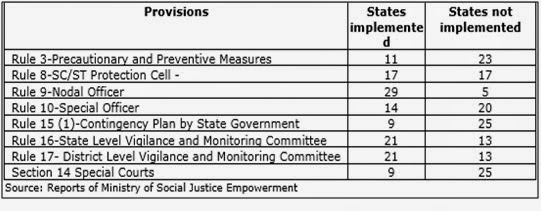
According to the data of Ministry of Social Justice and Empowerment, majority of states do not fulfill minimum statutory provisions as per the Act, 1989 and Rules, 1995. Following table shows the status of non-implementation of the provisions of SCs and STs (PoA) Act, 1989 and Rules 1995 by State Governments. 


Although there is provision in the PoA Act for the constitution of Special Courts to expeditiously try atrocity cases, in reality what SCs/STs experience is a huge pendency of their cases before the trial courts. Moreover, the conviction rate is very low. In fact, the conviction rate under the PoA Act is found to be much lower than in cases booked under IPC. According to the NCRB data, in 2013 the average conviction rate for crimes against Scheduled Castes and Scheduled Tribes stood at 23.8% and 16.4% respectively as compared to overall conviction rate of 40.2% relating to IPC cases and 90.9% relating to SLL (Special and Local Law) cases. The processing of reported cases for investigation and trail is very slow.  According to the NCRB data, 35645 cases are pending in different courts for trial. Large numbers of cases are pending in States such as Uttar Pradesh, Bihar, Odisha, Gujarat and Karnataka.

The National Advisory Council (NAC) during UPA government reviewed the provisions of law and cases of atrocities and found that certain forms of atrocities, though well documented, are not covered by the Act. NAC recommended for the incorporation of various IPC offences and other commonly committed offences under the perview of this law to ensure wider protection to the victims of caste atrocities. The National Commission for Scheduled Castes (NCSC) and Justice Punnaiah Commission critically examined deficiencies of the Act and has suggested various amendments to the Act. Human rights organizations have also highlighted various gaps in the enforcement of the Act and Rules. Ministry of Social Justice and Empowerment and Ministry of Home Affairs have issued various advisories to State governments to fill the gaps in the enforcement.

Status of Atrocities:

The National Crime Record Bureau (NCRB) data further exposes the poor implementation of the Act and its minimal impact in effectively dealing with caste based atrocities. The data reveals that the number and frequency of crime against SCs and STs are continuously increasing. The prevalent atrocities against SCs and STs includes incidents such as making SCs eat human excreta, and subjecting both SCs and STs to physical assaults, grievous hurt, arson, mass killings and rapes of SC/ST women, etc. Although the National Crime Records Bureau (NCRB) provides useful data that reveal the extent of atrocities committed against the SCs/STs, these data do not fully reflect the ground reality as most of the cases go unreported due to reluctance by police to register atrocity cases for various reasons. One also finds caste bias and corruption among the police force preventing registration and investigation of cases.

Even after low rate of reporting of crime under PoA Act, incidences of crime under this Act has increased from 11602 incidences in 2008 to 13975 incidences in 2013. The incidences of rape have shockingly increased from 1457 in 2008 to 2073 in 2013 (an increase of 42.27%).  There has been no mitigation with annual average of crimes registered against SCs/ST standing at 39408 and daily average being 108.

Proposed Amendments in PoA Act, 1989:

The literature and empirical data on caste atrocities reveals that it made nominal impact in the lives of SCs and STs. However, various assessment of the law reveals that it has created a sense of security and protection among the victims of the caste atrocity. Dalit and Adivasi victims have used it as a tool to assert their basic rights and combat with wrong social and cultural practices. The current situation of atrocities and status of cases pending in police station and in courts led stakeholder to advocate for amendment in the PoA Act, 1989.

The Scheduled Castes and The Scheduled Tribes (Prevention of Atrocities) Amendment Bill, 2014 introduced in the Lok Sabha on July 16, 2014 that replaces ordinance enacted by UPA government in March 2014 represents the consensus  of stakeholders to amend the law for better results.

The amendment Bill proposes substantial changes in the chapter on ‘Offences of Atrocities’ (Chapter-II) of the Principal Act. The proposed amendments attempts to increase number of IPC offences under the preview of this act. It also recognizes commonly practiced action in society to insult and harm dignity of person from SC and ST community as an offence. These offences are garlanding with footwear, compelling to dispose or carry human or animal carcasses, manual scavenging, attempting to promote feeling of ill-will against SCs or STs, imposing or threatening a social or economic boycott. The amendments in this chapter further specify duties of public servant in detail and prescribe punishment in case of any neglect of duty by the public servant. The common duties of public servant includes registration of FIR, furnishing a copy of information recorded by the informant in police station, to record statements of victims or witnesses, conduct investigation, file charge sheet within six days and keep records of document.

Addressing issue of long pendency of cases and low conviction rate under the Act, the amendment Bill proposes constitution of Exclusive Special Court and Special Courts to dispose cases within given time-frame. The provision in the bill ensures adequate number of courts so that every case can be disposed within the period of two months from the date of filling of the charge sheet.  The bill has inserted a new chapter namely ‘Chapter IVA’ in the principal Act, that describes the rights of victims and witnesses in detail. Some of the crucial rights of victims and witnesses are as follows:

·   Right of victims, their dependents and witnesses to access state’s support for their protection against any kind of violence, threats, coercion, inducement and intimidation. 
·   Right of victims to access special support from government, that arises because of their age, gender, educational disadvantage and poverty.
·  Right of hearing views of victims at any proceeding under this Act in respect of bail, discharge, release, parole, conviction or sentence of an accused.
·  Right of victims, their dependents, informants and witnesses to access facilities of relocation, rehabilitation and maintenance during investigation, inquiry and trail of the case.
·  Right to access information about trial, enquiry and trial such as recorded FIR and provision of laws and allied schemes of relief for victims, their relatives.
·     Right to access relief in cash or kind.
·    Right of atrocity victims and their dependents to take assistance from Non-Government Organizations, social workers and advocates.

Soon after the introduction of the amendment Bill in the Parliament, the Lok Sabha Speaker referred the Bill to the Parliamentary standing committee for further deliberation.

Conclusion:

The Scheduled Castes and the Scheduled Tribes (Prevention of Atrocities) Amendment Bill, 2014 introduced in budget session 2014-15 replaces ordinance brought in by UPA-II government in March 2014. The proposed amendments in the principal act comprehensively addresses issues of non-implementation, in-effectiveness and number of loopholes in the existing law as highlighted by various human rights organizations, Dalit activists and public institutions. The amendments in the Act will ensure wider protection and timely justice to the victims of caste atrocities. It has already been delayed for so many reasons, but now it is up to the Parliament and political parties to understand the urgency of the amendment Bill to provide relief to the SCs and STs who constitute almost one forth of Indian population.
 
Jeet Singh
 

Tuesday, 17 June 2014

Inclusion Of Internal Migrants In India

Photo Source:UNESCO
Free movement is a fundamental right of the citizens of India and internal movements are not restricted. The Constitution states: “All citizens shall have the right (...) to move freely throughout the territory of India; to reside and settle in any part of the territory of India
- Article 19(1) (d) and Article 19(1) (e), Part III, Fundamental Rights, The Constitution of India, 1950.
Approximately three out of every ten Indians are internal migrants! Despite this, internal migration has been accorded very low priority by the government, and existing policies of the Indian state have failed in providing legal or social protection to this vulnerable group.
National Sample Survey Office (2007–08) states that around 28.5 per cent of the 1.2 billion people in India are internal migrants (Census 2011). According to the UNDP Human Development Report (2009), the number of internal migrants (740 million) is nearly four times the number of international migrants (214 million).
 
As per NSSO (2007-08), around 80 per cent of total internal migrants are women. 91.3 per cent of women in rural areas and 60.8 per cent of women in urban areas cite marriage to be the most prominent reason for migration. However, researchers believe that the macro data reports do not capture the complete picture and miss the actual reasons for migration. About 30 per cent of internal migrants in India belong to the youth category (15-29 years age group).    
                
 Urbanization and Migration:
India’s urban population has increased from about 286 million in 2001 to 377 million in 2011, and is expected to increase to 600 million by 2030. This increase migration to urban areas is largely due to an increase in female migration (38.2 %in 199341.8 % in 1999-2000 45.6 % in 2007-08). The main reason driving this migration is expectations of “better employment opportunities.”
The report on Social Inclusion of Internal Migrants in India, UNESCO (http://unesdoc.unesco.org/images/0022/002237/223702e.pdf) highlights two developments in the evolution of urban centres that absorb the increasing migrant population.

Firstly, influx of people from varied regions poses a socio-economic and environmental challenge to cities. The outcomes are growth of second tier cities rapid urbanisation and the greater challenge to absorb the migrant population that eventually translates into increased poverty and inequality levels.

Secondly, focus of policy making changes from “welfarism to rights based approach” with the goal to ensure that basic services are accessible to all.
The loose definition of migration and the largely ignored concerns that it poses renders the design and delivery of their social inclusion undefined and hence, ineffective.
                                              Internal Migration: Myths and Realities
Despite its contribution, internal migration still suffers from several ill conceived notions. Highlighted below are some myths related to internal migrants that are countered with important realities:
  • Myth: Burden on destination cities vs. Reality: Forms cheap labor and thereby contributes to GDP
  • Myth Steal local jobs vs.Reality: Migrants typically provide essential services which the locals might not want to engage in
  • Myth: Migration can be stopped vs. Reality: Migration and urbanisation are integral part of economic and social development.
  • Myth: Inhospitable cities are best deterrents to internal migration vs. Reality: Harsh cities merely increase risks and costs of migration, reducing its development potential
  • Myth: Women migrate only for marriage vs. Reality: Women's labour migration and economic contribution
10 Key Areas for Inclusion of Internal Migrants
1. REGISTRATION AND IDENTITY
Migrants lack documentary proof of identity and local residence due to which they are excluded from access to legal rights, public services and social protection programmes (subsidised food, housing and banking services). In response to this, the Unique Identification (Aadhar) programme was created to combat the issue of registration.
2. POLITICAL AND CIVIC INCLUSION
 
A report on  Political Inclusion of Seasonal Migrant Workers in India: Perceptions, Realities and Challenges reveals that many migrants are unable to exercise their franchise because they have to travel in search of work and some return to their villages to exercise their franchise, because of this, they exercise limited political agency.
The Right of Citizens for Time Bound Delivery of Goods and Services and Redressal of their Grievances Bill, 2011 – could ensure a mechanism of accountability of public authorities. It would enable a citizen to file a complaint related to non-functioning of public authorities, violation of a law, policy or scheme or any grievance related to citizens charters, and offending officers could be penalized.
 
3. LABOUR MARKET INCLUSION
 
Migrants are mostly employed in the informal economy, devoid of social security and fair market, often working as construction workers, agricultural labourers,  vendors, etc. There are few Central Labour Laws for regulating conditions of work, but they remain undelivered.
 
4. LEGAL AID AND DISPUTE RESOLUTION
 
As migrants are predominantly engaged in the informal sector, migrants have no protection under labour laws. Government’s safety measures remain unimplemented, and minimum wages are not delivered. 
Poor literacy levels and no awareness act as an impediment in claiming rights and entitlements.
 
 5. INCLUSION OF WOMEN MIGRANTS
 
The current discourse on migration has failed to adequately address gender-specific migration experiences. The design of the Census and NSSO data surveys should be amended to better capture the actual reasons of migration. Women migrants, especially those in lower-end informal sector occupations, remain invisible and discriminated against in the workforce.
 
6. INCLUSION THROUGH ACCESS TO FOOD
 
In order to access subsidised grain and other supplies under the PDS scheme, beneficiaries must present a ration card that is given to them at their usual place of residence and is not transferrable. Such clauses imply that migrants are unable to access the PDS system at destination.
The National Food Security Bill 2011 passed this year aims to guarantee food and nutritional security in India, recognized that:  “The migrants and their families shall be able to claim their entitlements under this Act, at the place where they currently reside.”
 
 7. INCLUSION THROUGH HOUSING
 
Migrants face difficulties in accessing housing and other basic amenities. They often live in urban slums, facing constant threats of displacement and eviction from government officials. Shelter solutions show little appreciation for the needs of seasonal migrants.
 Suggestions:
  • Affordable rental housing to affordable private housing, with an eventual policy shift towards provision of de facto residential rights and housing
  • In-situ upgradation of existing slum dwellings could be a first step towards ensuring basic services for migrants living in slums
  • Employers and contractors also need to play a role in securing shelter for migrant workers, and experiments with dormitory accommodation provided by employers (as undertaken in China0
8. EDUCATIONAL INCLUSION
 
Seasonal migrants often take their children along when they migrate, which negatively impacts their regular schooling. This is one of the reasons for high dropout rates in schools in many states. This further breeds inter-generational transmission of poverty.
Despite the Child Labour (Prohibitions & Regulation) Act, 1986, children work for long hours as unregistered workers often in harmful industries on piece rate basis

 Suggestion:
  • The multiplication of seasonal hostels to promote the retention of children in schools in source areas
  • The establishment of worksite schools at the destination with systems to transfer enrolment, attendance at and credits to formal schools, and bridge courses and remedial education for return migrant children
  • Establishing peripatetic educational volunteers who can move with the migrating families, initiating strategies for tracking children by issuing migratory cards, and making the school calendar flexible to accommodate migrant children, including in local government schools in both rural and urban areas,
9. PUBLIC HEALTH INCLUSION
 
Migrants are exposed to health risks including HIV, malaria and tuberculosis, and occupational health hazards such as respiratory problems, lung dseases, allergies, kidney and malnutrition.

 10. FINANCIAL INCLUSION
 
Migrants are unable to access banking facilities since they do not have the necessary documentation to fulfil the Know Your Customer (KYC) requirements of banks, including proof of identity and proof of address. Suggestions
  • Linking migrants to branchless banking and business correspondents along with incorporating flexibility in bank procedures
  • Target banking services in geographical areas with high out-migration
                                                Prepared by Ashwin Varghese and Mahima Malik


Monday, 9 June 2014

Finance Gap Affecting Growth of Women-Owned Enterprises: IFC study


Financial inclusion is considered to be instrumental in empowering women as advancing credit to women, who own businesses, improves their economic stature and independence across the globe. In the Indian context, encouraging greater access to financial services becomes more relevant given the various degrees of socio-economic discrimination  women are subjected to in their daily lives. The following article discusses the findings of a report titled Micro, Small, and Medium Enterprise Finance: Improving Access to Finance for Women-owned Businesses in India’ (Report) published on March 11, 2014 by the International Finance Corporation. The research report focuses on the opportunities, challenges, and way forward to improving access to finance for women-owned businesses in India.
In India, there are around 3.01 million women-owned businesses which account for about 10 percent of the total micro, small and medium enterprises (MSME). They collectively contribute around 3.09 percent of the total industrial output and employ over 8 million people.

As data reveals, 97.2 percent of women-owned businesses fall under the micro industries category. This concentration of industries indicates reduced growth capacities and opportunities these companies caused due to the huge gap in the demand and supply of financial services to the same.

According to the report, the financing gap for women-owned businesses amounts to Rs. 6.37 trillion in 2012. This accounts for 73 per cent of the total requirements by MSMEs in the country.

Currently, the various funding sources for women-owned business include formal, semi-formal and informal sources. Out of these available sources, women-run enterprises, much like the general trend in the MSME sector, largely depend on informal lending sources that constitute 92 per cent of the total share of funds provided in 2012. There are 3 million women entrepreneurs in India, but only 3 per cent have access to finance from formal financial institutions.
Barriers to financial inclusion of women
The major factors that impeded financial inclusion of women entrepreneurs are as follows:
Lack of adequate collateral: Due to persisting social restrictions around inheritance and land ownership, women in India do not have ownership of property or enough assets to use them as collateral for availing loans at low interests from formal funding sources. Even when women do own legal rights to properties, the male members either get them legally transferred to themselves or exercise control over them even without legal rights or title deeds.  Therefore, poor financial literacy amongst women and lack of agency of women in terms of title deeds restricts their capacity to ensure collateral for credit.
Lack of formal loans to women:   As the report mentioned above points out that approximately 90 percent of women-owned enterprises are in the informal sector and 78 percent of them belong to the services sector. Banks traditionally identify the informal and service sectors as high risk group as interest returns remain uncertain. This is mainly because of the following reasons:
a)      lack documents and papers essential for banking services, and
b)      increased number of smaller loans shoots up the cost for the banks to administer and provide equal financial services to all.
Absence of women employees in bank: Women employees, who are believed to act as mediators enabling more women to come up to banks to avail banking services, constitute less than 20 percent of the bank’s workforce.
Apart from the afore mentioned factors, lack of financial awareness, absence of support from the male members of the family and lack of confidence to approach financial institutions act as the major barriers.

Government Response
The MSME ministry launched the government’s only financing scheme for women entrepreneurs- Trade Related Entrepreneurship Assistance and Development (TREAD)-in 2008. This is the only targeted approach on the part of the government to provide finances focusing on the MSMEs. However, as against the target of Rs. 38 million only Rs. 7.7 million were disbursed as loan amount in 2012.

The central schemes like the Prime Minister’s Rozgar Yojana, the Swarna Jayanti Shahari Rozgar Yojana and the Swarna Jayanti Gram Swarozgar Yojana currently provide funds to MSMEs. But the net contribution of these schemes is a mere 7 per cent of the total share of funds supplied to women-owned MSMEs.
Lastly, by establishing more branches of Bharatiya Mahila Banks, the government aims at catering to the banking requirements of women and promote their economic empowerment.

Conclusion
Although microfinance plays a key role in encouraging individual women belonging to the low income group, who require loans to run tiny enterprises, its mono-product environment, singular delivery model, lack of flexibility, and shorter-tenure loans with limited amount of credit restrict their scope to low-income women or micro entrepreneurs rather than women-owned MSMEs.

Considering the gradual rise in the number of women entrepreneurs in India, there is an urgent need to encourage banks to step up formal funding of women entrepreneurs.

Pallavi Ghosh