Thursday, 16 October 2014

Caste Atrocities in India: Time to Review the PoA Act, 1989

The constitutional commitment of equality, liberty, justice and dignity to all Indian citizens is the expression of our vision of building a nation without any discrimination including deep-rooted discrimination based on caste. In the past 68 years of independence, this commitment made in the Preamble has been translated into action through various public policies to abolish discrimination. Yet caste discrimination remains a widespread phenomenon throughout India. The cruelest outcome of caste discrimination against Dalits and Adivasis is the physical violence against them by socially advantaged caste groups in India. Recognizing such crimes and vulnerability of Dalits and Adivasis, the government of India enacted ‘The Scheduled Castes and Scheduled Tribes (Prevention of Atrocities) Act’ in 1989 (PoA Act) to deter such violence and ensure justice and protection to them. However, its implementation remains very weak and the vulnerability of SCs and STs has barely improved. Dalit rights organizations and various other public institutions indicated towards non-implementation of the law, in-effectiveness of law to deter commonly committed caste base atrocities, lack of statutory arrangements in the states, corruption in police system and influence of caste system in public institutions. Considering all these loopholes in the Act, it has been demanded by various stakeholders to amend this law in order to ensure higher protection of victims and prevent caste-based atrocities. UPA-II government in the end of its tenure brought an ordinance to amend the PoA Act in March 2014. The newly formed NDA government introduced ‘The Scheduled Castes and the Scheduled Tribes (Prevention of Atrocities) Amendment Bill, 2014 in the Lok Sabha to replace the ordinance

The Scheduled Castes (Dalits) and Scheduled Tribes (Adivasis) together accounts around one fourth of Indian population. Caste system deprives this entire section of population from enjoying a life as it is articulated in the Preamble of the Indian Constitution. Practices of the caste system such as untouchability and discrimination many times lead to the gross physical atrocities. The literature on atrocities shows that it is an all-India phenomenon legitimized by same principle of caste hierarchy. Government of India enacted The Untouchability (Offences) Act in 1955 to abolish practices of untouchability and protect rights of individual. Even after this legislative mechanism, frequency of atrocities against Dalits and Adivasis remain unchanged. Under the pressure from Dalit Members of Parliament (MPs), the Government of India started monitoring atrocities against SCs from 1974 and in the case of STs from 1981 onwards, with special focus on murder, rape, arson and grievous hurt.

The caste system is so deeply rooted in Indian society that mere monitoring of atrocities and enacting a law to abolish untouchability did not result into betterment of Adivasis and Dalits. The socially and culturally legitimized caste system leads to the complex manifestations such as discrimination, untouchability, atrocity on vulnerable sections of the society. The enactment of PoA Act in 1989 as a special law recognized complexity of caste base atrocities and higher vulnerability of victims. This special law treats various IPC and other offences against STs and SCs by any non ST and SC member in a different manner. It prescribes stronger punishment and provides protection to the victims. The Act states that, “despite various measures to improve the socio-economic conditions of SCs and STs, they remain vulnerable. They are denied a number of civil rights; they are subjected to various offences, indignities, humiliations and harassment. They have, in several brutal incidents, been deprived of their life and property. Serious atrocities are committed against them for various historical, social and economic reasons .”

Implementation of the Act

During two decades of its implementation the PoA Act ensured justice, protection and rehabilitation for thousands of victims of caste atrocities. . It also helped to generate awareness around basic human rights. Dalits and Adivasis have utilized this law to assert their rights and due share in society. However, various obstacles have been identified in its smooth implementation and delivering justice to the victims. According to a NHRC report on Status of Implementation of SCs and STs (Prevention of Atrocities) Act, 1989, police resort to various machinations to discourage SCs/STs from registering cases, to dilute the seriousness of the violence and to shield the accused persons from arrest and prosecution. FIRs are often registered under the Protection of Civil Right Act and IPC provision, which attract lesser punishment than PoA Act provision for the same offence.

The National Coalition for Strengthening SC & ST Prevention of Atrocity Act (a network of civil society organization and Dalit activists) identified following major deficiencies of the Act and its implementation :

·         Under reporting of the cases under the Act and deterred from making complaints of atrocities.
·         Deliberately not registering cases under appropriate sections of the Act.
·         Delay in filing charge sheet
·         Not arresting accused and the ones who are arrested are invariably released on bail.
·         Filing false and counter cases against Dalit victims by accused.
·         Compensation prescribed under the Act 16 is invariably not paid.
·         Victims have no access to legal aid.
·         Non-implementation of statutory provisions in various States under the Act and Rule, 1995.


According to the data of Ministry of Social Justice and Empowerment, majority of states do not fulfill minimum statutory provisions as per the Act, 1989 and Rules, 1995. Following table shows the status of non-implementation of the provisions of SCs and STs (PoA) Act, 1989 and Rules 1995 by State Governments. 
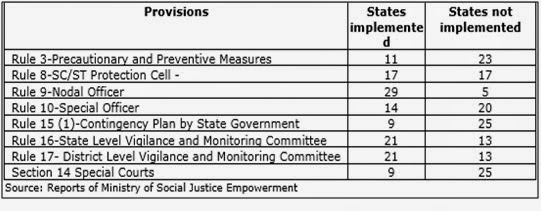

Although there is provision in the PoA Act for the constitution of Special Courts to expeditiously try atrocity cases, in reality what SCs/STs experience is a huge pendency of their cases before the trial courts. Moreover, the conviction rate is very low. In fact, the conviction rate under the PoA Act is found to be much lower than in cases booked under IPC. According to the NCRB data, in 2013 the average conviction rate for crimes against Scheduled Castes and Scheduled Tribes stood at 23.8% and 16.4% respectively as compared to overall conviction rate of 40.2% relating to IPC cases and 90.9% relating to SLL (Special and Local Law) cases. The processing of reported cases for investigation and trail is very slow.  According to the NCRB data, 35645 cases are pending in different courts for trial. Large numbers of cases are pending in States such as Uttar Pradesh, Bihar, Odisha, Gujarat and Karnataka.

The National Advisory Council (NAC) during UPA government reviewed the provisions of law and cases of atrocities and found that certain forms of atrocities, though well documented, are not covered by the Act. NAC recommended for the incorporation of various IPC offences and other commonly committed offences under the perview of this law to ensure wider protection to the victims of caste atrocities. The National Commission for Scheduled Castes (NCSC) and Justice Punnaiah Commission critically examined deficiencies of the Act and has suggested various amendments to the Act. Human rights organizations have also highlighted various gaps in the enforcement of the Act and Rules. Ministry of Social Justice and Empowerment and Ministry of Home Affairs have issued various advisories to State governments to fill the gaps in the enforcement.

Status of Atrocities:

The National Crime Record Bureau (NCRB) data further exposes the poor implementation of the Act and its minimal impact in effectively dealing with caste based atrocities. The data reveals that the number and frequency of crime against SCs and STs are continuously increasing. The prevalent atrocities against SCs and STs includes incidents such as making SCs eat human excreta, and subjecting both SCs and STs to physical assaults, grievous hurt, arson, mass killings and rapes of SC/ST women, etc. Although the National Crime Records Bureau (NCRB) provides useful data that reveal the extent of atrocities committed against the SCs/STs, these data do not fully reflect the ground reality as most of the cases go unreported due to reluctance by police to register atrocity cases for various reasons. One also finds caste bias and corruption among the police force preventing registration and investigation of cases.

Even after low rate of reporting of crime under PoA Act, incidences of crime under this Act has increased from 11602 incidences in 2008 to 13975 incidences in 2013. The incidences of rape have shockingly increased from 1457 in 2008 to 2073 in 2013 (an increase of 42.27%).  There has been no mitigation with annual average of crimes registered against SCs/ST standing at 39408 and daily average being 108.

Proposed Amendments in PoA Act, 1989:

The literature and empirical data on caste atrocities reveals that it made nominal impact in the lives of SCs and STs. However, various assessment of the law reveals that it has created a sense of security and protection among the victims of the caste atrocity. Dalit and Adivasi victims have used it as a tool to assert their basic rights and combat with wrong social and cultural practices. The current situation of atrocities and status of cases pending in police station and in courts led stakeholder to advocate for amendment in the PoA Act, 1989.

The Scheduled Castes and The Scheduled Tribes (Prevention of Atrocities) Amendment Bill, 2014 introduced in the Lok Sabha on July 16, 2014 that replaces ordinance enacted by UPA government in March 2014 represents the consensus  of stakeholders to amend the law for better results.

The amendment Bill proposes substantial changes in the chapter on ‘Offences of Atrocities’ (Chapter-II) of the Principal Act. The proposed amendments attempts to increase number of IPC offences under the preview of this act. It also recognizes commonly practiced action in society to insult and harm dignity of person from SC and ST community as an offence. These offences are garlanding with footwear, compelling to dispose or carry human or animal carcasses, manual scavenging, attempting to promote feeling of ill-will against SCs or STs, imposing or threatening a social or economic boycott. The amendments in this chapter further specify duties of public servant in detail and prescribe punishment in case of any neglect of duty by the public servant. The common duties of public servant includes registration of FIR, furnishing a copy of information recorded by the informant in police station, to record statements of victims or witnesses, conduct investigation, file charge sheet within six days and keep records of document.

Addressing issue of long pendency of cases and low conviction rate under the Act, the amendment Bill proposes constitution of Exclusive Special Court and Special Courts to dispose cases within given time-frame. The provision in the bill ensures adequate number of courts so that every case can be disposed within the period of two months from the date of filling of the charge sheet.  The bill has inserted a new chapter namely ‘Chapter IVA’ in the principal Act, that describes the rights of victims and witnesses in detail. Some of the crucial rights of victims and witnesses are as follows:

·   Right of victims, their dependents and witnesses to access state’s support for their protection against any kind of violence, threats, coercion, inducement and intimidation. 
·   Right of victims to access special support from government, that arises because of their age, gender, educational disadvantage and poverty.
·  Right of hearing views of victims at any proceeding under this Act in respect of bail, discharge, release, parole, conviction or sentence of an accused.
·  Right of victims, their dependents, informants and witnesses to access facilities of relocation, rehabilitation and maintenance during investigation, inquiry and trail of the case.
·  Right to access information about trial, enquiry and trial such as recorded FIR and provision of laws and allied schemes of relief for victims, their relatives.
·     Right to access relief in cash or kind.
·    Right of atrocity victims and their dependents to take assistance from Non-Government Organizations, social workers and advocates.

Soon after the introduction of the amendment Bill in the Parliament, the Lok Sabha Speaker referred the Bill to the Parliamentary standing committee for further deliberation.

Conclusion:

The Scheduled Castes and the Scheduled Tribes (Prevention of Atrocities) Amendment Bill, 2014 introduced in budget session 2014-15 replaces ordinance brought in by UPA-II government in March 2014. The proposed amendments in the principal act comprehensively addresses issues of non-implementation, in-effectiveness and number of loopholes in the existing law as highlighted by various human rights organizations, Dalit activists and public institutions. The amendments in the Act will ensure wider protection and timely justice to the victims of caste atrocities. It has already been delayed for so many reasons, but now it is up to the Parliament and political parties to understand the urgency of the amendment Bill to provide relief to the SCs and STs who constitute almost one forth of Indian population.
 
Jeet Singh
 

Monday, 13 October 2014

Forest Rights Act and Land Ownership in India


Source: the Hindu
Introduction and Brief Background
Forests in India house over 250 million people whose home, hearth and livelihood comes from their forest dwellings for generations. However, forest dwellers in India are among the most marginalized and neglected sections of the society comprising primarily of tribal and Dalit communities whose livelihood depends on the forest produce of the land that they have used for centuries.

During the colonial era, the draconian Indian Forests Act (IFA) was enacted in 1927 divided the forest into the Reserved (no human activity allowed) and Protected (controlled human activity allowed) categories. Some felling was allowed in the latter category, but cultivation and livestock grazing were banned in both. This destroyed the traditional way of life.

The abolition of the Zamindari system exacerbated the situation as more common lands were nationalized and converted into protected forests. This was later amended and the traditional occupants were given titles based on the length of occupancy. This, however, gave disproportionate power to the Patwaris (keeper of land records), and given the non-existence of ownership records corruption became rampant. The FRA sought to rectify this by providing a clear, transparent and environmentally friendly procedure for the resettlement of the people and displaced wildlife.
However, the act is not serving the purpose with which it was enacted. Where is the implementation lagging behind? Would the current government keep up the Centre’s commitment of equality in land ownership notwithstanding the differences political ideology with the previous UPA government? What exactly is the FRA? These are some of the issues examined in this essay.

The Scheduled Tribes and Other Traditional Forest Dwellers (Recognition of Forest Rights) Act, 2006

The Scheduled Tribes and Other Traditional Forest Dwellers (Recognition of Forest Rights) Act, 2006 (FRA) was enacted in 2006 to address the sever shortcomings of the 1927 act. The IFA resulted in the alienation of tribals and other forest dwellers. It is an act which protects the land ownership titles in the tribal belt of India and had been demanded for long to safeguard the interests of the most marginalized people of the country. However, the implementation record (including guaranteed land holdings under the act) has been poor.

Discrepancies in tribal forest land allocation and redistribution has also been at the centre of India’s Left Wing insurgency in what is called the Red Corridor. Therefore, he 2006 act’s importance multiplies in not only addressing the injustice done to the traditional forest dwellers over centuries, but also as a means to combat what has been called India’s worst national security crisis.

The 2006 act was radically democratic in many ways as it acknowledged the historical injustices done to the forest dwelling communities and set a forward-looking path to correct those. There are twelve types of rights enlisted in the 2006 act to undo the damage that has already been done and these include rights to land occupation, forest produce, both timber and non-timber, management of community forests and home and hearth. It also empowers and makes accountable the traditional forest dwellers to protect the biodiversity, water resources and other resources of the forest as well as catchment areas and seeks to establish a community based forest administration in the country with the Gram Sabhas at the helm of affairs. The land ownership titles will be ascertained to the maximum limit of 4 ha per person by a committee comprising the District Collector, the Divisional Forest Officer and the Superintendent of Police.

There are many misconceptions surrounding the act for which it has come under criticism. Many people believe that the FRA is meant to redistribute land up to a maximum ceiling of 4 hectares per person. However, the truth is that this act is not a land redistribution act and does not empower anyone to do so. On the issue of land, the FRA requires the state and central government to legally recognise the lands as revenue lands on which forest dwellers have been carrying out farming prior to 13 December 2005.

For non-Scheduled Tribes (STs), this recognition comes after proving that they have been farming on the land in question for the past 75 years. As per the FRA, the traditional forest dwellers and STs will only receive rights to ‘land under their occupation’ and no more, for the time specified up to a maximum of 4 hectares per person. Any claims over the stipulated 4 hectares will not be entertained. No new land distribution will take place and the titles given as per the act cannot be sold or transferred, except through family hierarchy. It is not a welfare scheme and deals with defining the forest land and its occupation.

In 2012, then Minister for Tribal Affairs, Mr. Kishore Chand Deo had written a letter to the CM’s of states, urging them to implement the act properly. However, despite all the efforts by the previous government and civil society activists, the implementation record of the act has remained poor. Moreover, widespread corruption which still exists in the process of implementation has hindered the powers of the act substantially. 

Critics of the FRA say it was enacted by the government for privatizing natural resources and making vote banks out of the forest dwellers. But the basic principles of the act were largely misinterpreted and contorted based on state-wise implementation record.

Conclusion

The enactment of the 2006 FRA is an example of inclusive, democratic and enabling legislation which came in a favorable pro-poor political environment. However, the implementation rests with local authorities and state governments where the failure is stark. According to Ministry of Tribal Affairs’ report from January 2014, 36, 54,420 claims have been filed and 14, 18,078 titles have been distributed. Further, 15,864 titles were ready for distribution. A total of 31, 06,690 claims have been disposed of (85.01%). Unfortunately, there are no records of details of the amount of land under each title. Whether these gains for the forest dwellers are consolidated in forms of actual substantive rights and access remains an open question. There is also no readily available record of uses for such land. Various non-government report states that this number is grossly inflated and titles to a full authorized 4 ha per person are rare in all the states.

There are also several cases on encroachment still pending in the courts of different states wherein, lack of proof of occupation has led to a traditional forest dweller to be incarcerated as a squatter.

The role of Gram Sabhas has also not been exemplified under the act yet on ground. Moreover, mining activities on traditional forest land in some of the states by corporate houses is still going unnoticed. 

In spirit, this act is phenomenal but the leakages in implementation reduce it to the status of just another act which is supposed to work but isn’t.   

The current government needs to look beyond political differences and keenly push for a better implementation of the FRA under due process. This is one of the landmark legislations which follow the democratic principles enshrined by our founding fathers in our constitution. 


Medha Chaturvedi

Friday, 10 October 2014

Development Roadmap: Threat to India’s Environment and Wildlife

The development roadmap of present government as indicated through their recent

Photo: Survival International
economic policies would sharply pose a threat to India’s marginalized communities, green environment and precious wildlife. Thus with the dilution of the Forest Conservation Act, 1980 by the Ministry of Environment and Forest to grant forest clearances for facilitating development projects is a step towards this. The most sensitive areas around tiger reservation, national parks and sanctuaries now would be under the grab of project developers as they have been de-linked from wildlife assessment impacts.

Such kind of policy decision would necessarily help the developers to go ahead with the linear projects of irrigation, canals, highways and power lines, but by massive destruction of India’s rich forest areas and its wildlife. Though providing funds for compensatory afforestation is mandatory, but fair utilization of this fund would be a challenge.

 The present government has also done away with the need for consent of tribals for forest and mine openings in their traditional lands, which clearly violates their rights. The state government can no longer put any additional conditions to protect forest and biodiversity for those projects which have been cleared from the Centre.

All these steps are taken with a justification that India need development, and all its citizens must enjoy the fruits of it. But such a policy roadmap to modernize India clearly in contradiction with the issue of the rights of tribals over their forest land, which would also be at the cost of precious environment and wildlife. This development policy is unsustainable and undemocratic. Can this development ensure the well being of the last and the least in the country or is it a path towards more inequity in the economy?

Read More

 
by RGICS

Wednesday, 8 October 2014

Billionaires versus the Rest: India’s Skewed Market and Wealth Concentration

Photo Source: Business Today
Widening income inequality between the rich and poor in India is an alarming concern of the policy makers. The report of the United Nations Economic and Social Commission for Asia and Pacific (UN - ESCAP) currently has shown that the crude estimation of income inequality - the Gini coefficient has increased in India’s post liberalised phase from 30.8 in 1990s to 33.9 in 2000s. [i] 

Several other studies also reflect similar findings of high income inequality in India, which has gone high in post economic liberalisation phase in 1990s. The idea of liberalisation was to initiate the role of market by ending India’s License Raj system, which can help India to become a competent player in global and open market system. Open market economy then brought a startling growth of about 8% percent for almost a decade in India. Such growth has brought in many changes in the country including successful creation of super-rich club of billionaires. The findings of Gandhi and Walton show that in mid-1990s, India began with two billionaires, worth a combined total of $3.2 billion, and by 2012 there were 46 billionaires with total net worth of $176.3 billion.[ii] The latest newspaper report says that the number of billionaires in India has nearly doubled in 2014 to 109 from 59 in 2013, with total net worth of $ 422 billion. The top 10 of them have wealth worth $ 138.04 billion. Mukesh Ambani is the richest person in India with wealth worth $ 26.89 billion. His wealth has increased by about 37% from last year. Gautam Adani, the 10th richest person in the raw, whose wealth has increased by about 152% from last year and worth $ 7.17 billion. The average age of Indian billionaire is 62, where six of them are below 40 years.[iii] The ratio of total billionaire wealth to gross domestic product (GDP) has grown from mere 1% in mid-1990s to 6.6% in 2006 to 9.9% in 2012.[iv] In 2014, the ratio between the billionaire wealth and the GDP has triggered up to 22%. Only the top ten billionaires share about 8.09% of India’s GDP. It is also interesting to see the regional concentration of these billionaires within India. Mumbai, the financial capital of the country shares 70 of them followed by Delhi, the administrative capital of India sharing 37, and Bangalore, the IT capital of India sharing 23 of them. It is primarily therefore a metropolitan club of billionaires in India monopolising the asset holding and economic power, which bound have a sharp reflection on inequality with rest of India. The NRIs from two nations UK and UAE have maximum contribution in this club with L. K. Mittal being the richest person from UK with wealth worth Rs 97 K crores.

On the brighter side, such statistics verify the fact that India’s economy has become much vibrant in the liberalisation phase. The rise of such rich class as argued by Gandhi and Walton is both due to business dynamism and business oligarchy. Business dynamism through an active role of corporate sector is significant in India’s economic success story. Thus IT, software industry, biotech, pharmaceuticals, finance and banking, manufacturing have contributed fairly in Indian economy. But India still has a high oligarchic and undemocratic economic and business structure which results such heavy concentration of wealth. Thus ‘rent-thick’ sectors like real estate, infrastructure, construction, mining, telecom etc., still continue to be dominated by India’s traditional merchant classes, Khatris and upper caste communities.[v] ‘Rent-thick’ sectors are those where returns often flow from monopolistic economic power by holding scarce resources and deriving maximum profit. According to Crabtree, about half of India’s billionaires acquired their wealth in such ‘rent-thick’ sectors.[vi]

It is alarming to see that only about few dozens of billionaires (109) in the land of magnanimous 1.25 billion population shares 22% of GDP, and economic rules of the game are still rigged in favour of those handful elites. Such concentration of wealth has been possible due to the functioning of an undemocratic and non-competitive market even in the economic liberalisation phase, which has not worked in favour of vulnerable and poorest section of the society. Fair competition therefore can be a panacea, which refers to a market situation in which each entrepreneur can have an independent bargaining power to achieve the business objectives. Competition according to a Government of India report bound to stimulate innovation and productivity, having optimum allocation of resources in the economy. It guarantees protection of consumer interests, reduces costs and improves quality. This can accelerate growth and development by preserving economic and political democracy.[vii] In practice Indian markets are highly discretionary and weak regulatory environment according to an Oxfam report has set the tune for anti-competitive business practices, and fails miserably to be inclusive in nature. Therefore to create a fair competition, equal opportunity has to be the central tenet, which alone can bring inclusive modern societies, and a socialist structure of the market.[viii] Fair competition can break India’s business oligarchy and economic enclavity, which in turn can provide space for other players to grow. Thus, there arises the need to have a proper regulatory environment which can ensure a healthy competition in the economy so that all business enterprises can grow, expand and stimulate economic development of a country. Competition policy under Competition Act 2002 of India is one such step which attempts to prohibit anti-competition agreements through Competition Commission of India. Well functioning of such policy can ensure competitive outcomes and can prevent concentration of wealth and economic power.

 Rakhee Bhattacharya


Notes
 
[i]‘Poor-rich gap growing in India, Asia Pacific:UN-ESCAP, at
[ii] Aditi Gandhi and Michael Walton, ‘Where Do India’s Billionaires Get their Wealth?’, EPW, Vol XLVII, No 40, 2012
[iii]  Piyush Pandey, ‘Adani breaks into top 1- rich club as wealth jumps 152%’, TheTimes of India, September 17, 2014, New Delhi
[iv] Aditi Gandhi and Michael Walton, ‘Where Do India’s Billionaires Get their Wealth?’, EPW, Vol XLVII, No 40, 2012
[v] ibid
[vi] J. Crabtree, ‘India’s Billionaires Club’, Financial Times, 16 November, 2012
[vii] ‘Competition Protection’, Report by Government of India
  at, http://business.gov.in/growing_business/competition_pro.php
[viii] Working for the Few: Political Capture and Economic Inequality’,  178 Oxfam Briefing paper, January 20, 2014

Tuesday, 30 September 2014

In Defence of the Right to Fair Compensation and Transparency in land Acquisition, Rehabilitation and Resettlement Act, 2013

Photo source: FRONTLINE
The post liberalization Indian economic boom continues to create a voracious appetite for space to meet the demands of industrialization, infrastructure building, urban expansion and resource extraction. The emerging modern market completely depends on land resources, but Asian countries like India and China are facing a scarcity of land, specifically non-agricultural land. Indeed, land acquisition has become a most vexing problem for policymakers in India. Names like Singur, Nandigram, Kalinganagar, Jaitapur, and Bhatta Parsaul have entered the human lexicon as poignant metaphors of social conflict. The Left Front, which built a remarkable political hegemony in West Bengal largely on the basis of Operation Barga and land reforms, has been brought to its knees after a botched attempt at wresting a thousand acres for a car factory, illustrating how land issues have seismic potential in our political landscape. For those whose lands were acquired and people whose livelihoods depended on the lands acquired, a great human tragedy has unfolded. Independent estimates place the number of people displaced following development projects in India since independence at 60 million. Only a third of these people were resettled in a planned manner.

In this context, the Right to Fair Compensation and Transparency in Land Acquisition, Rehabilitation and Resettlement Act, 2013 offers a genuine protection and expansion of the rights and interests of the poor and vulnerable - as seen in its decentralized, participatory and time-bound approach, its emphasis on a just and informed and transparent process, inclusion of hitherto ignored aspects like rehabilitation and resettlement, comprehensive compensation package, ensuring improvement in standards of living of the all affected. In view of the recent criticisms from the right wing, several other political parties and the industrial lobby, there is need to protect the said Act from any amendments that would fundamentally alter its democratic principles and its ideal of social justice. At the heart of the matter, the question is not that of higher GDP on the back of the neoliberal political agenda but rather how can broad based development be achieved, keeping in mind the reality that growth effects are diffused through a political-economy of difference – that of class, caste, region etc. 

It has been suggested that the consent clause of the 2013 Act has virtually halted the process of land acquisition, that the Act violates federal provisions of the Indian constitution and the process of acquisition outlined, including the social impact assessment (SIA) exercise, is too cumbersome and impractical. Is there any merit in these criticisms?

The Act requires consent of 80% of all land losers in case of acquisition by private companies and 70% in case of PPPs. This provision has been severely criticised for making land acquisition virtually impossible, for dissuading private investment and industrial development and consequently being anti-growth, anti-jobs and therefore anti-people. What is not being voiced enough is that these provisions have been introduced in light of the experience of the previous colonial legislation which gave draconian powers to the state without any safeguards against the abuse of this power or against acquisition.

Criticisms against the Act for being against the federal spirit do not hold ground. It should be noted that though land is a state subject, land acquisition is mentioned in the concurrent list. The new Act is explicit on active state participation in the process of acquisition. Furthermore, crucial decision-making powers pertaining to whether land should be acquired, purchased or leased; the extent to which multi-cropped irrigated land can be acquired; ensuring rehabilitation and resettlement; determination of compensation etc vest with the states. Clearly then, all efforts have been made to protect the federal principle.

The importance of SIA and public hearings is unquestionable. It allows for a dialogue amongst stake-holders, to establish who will be affected (individual or community), what will be consequences of acquisition for them, what is it that the affected want and moreover, SIA encourages participation, sharing of information, transparency and accountability. This mechanism is now being critiqued as a complex and time-consuming administrative hassle for it involves an initial socio-economic profiling of the area, multiple hearings at different levels, allows time for information dissemination at various stages of the acquisition process etc. However, it should be highlighted here that the SIA exercise is time bound and the Act states that it has to be completed within six months. Removing or diluting this clause goes against the very grain of a just polity.     

There are various other clauses regarding which changes have been sought. For example, one observation is that penalty provisions against civil servants in case of any misconduct are too severe. It should be remembered though that assigning responsibility for one’s acts and holding them liable to them should not be considered as a negative feature, particularly given the way things work in this country. The comprehensive compensation package is seen as impractical, unsustainable and as substantially increasing the cost of land acquisition and making projects unviable. But for the first time, the interests and rights of the most vulnerable and marginalized sections of the Indian society have been protected and expanded. In India, land is not just a factor of production, a source of monetary income and employment; it is much more, land is an identity, and is an emotional and a social asset, the value of which cannot be gauged or is very difficult to be estimated only within economic and livelihood frames. 


The Right to Fair Compensation and Transparency in Land Acquisition, Rehabilitation and Resettlement Act, 2013 was drafted and subjected to extensive public debate before being enacted. Now changes are being proposed to it without any substantive basis, without public discussion and dialogue amongst the stakeholders. The Act is pro-poor, pro-tribals and pro-farmers; and is seen as an important mechanism to counter Naxalism. In fact, this legislation provides an opportunity for wider reforms, for instance, digitisation of land records, in the arena of registry etc. It has been in operation for too short a duration to judge its performance and any unilateral top-down changes may well spark violence – the very anti-thesis of the new Act’s objective. A briefing was organised by RGICS on 7th August 2014 to discuss the proposed amendment to this Act. The representatives of the farmer organisations such as Delhi Grameen Samaj, Bharatiya Kisan Union and Ekta Parishad have expressed their concerns to the over ten Members of Parliament. Shri. Jairam Ramesh, who was the main architect of this Act has an extensive discussion with the representatives. The Members of Parliament and farmer groups came to a consensus that a continuous nation-wide awareness campaign to mobilise support against the amendments is need of the hour to protect such well-crafted pro-poor revised Act, which came into existence after more than a century by replacing the colonial pro-corporate Act of 1897.  

Ishita Mehrotra

Thursday, 21 August 2014

Financial Sector in India

Financial sector plays a vital role in any economy particularly emerging economies like India which
Photo source: IMARTICUS
needs to harness its full potential. Indian financial sector is in early stage of evolving on an inclusive financial system keeping in view of the aspirations of the billion plus people in the country. Banking sector is an indispensable organ of the financial sector for servicing various intermediations. The efficient intermediation of financial system among people enables to achieve higher economic and social development.

Since the economic reforms process which began in 1991, the nature of financial intermediation has undergone several transformation with other intermediaries such as the Non-Banking Financial Companies (NBFCs), insurance, pension funds and mutual funds emerging as the new mechanisms for channelizing savings to investments in the country. Besides, there are other forms of financial intermediation which emerged during in the process of systemic reforms including equity and debt markets, financial products like forwards, futures and other derivatives instruments which have the capacity of reallocating capital to more efficient use in the economy.

Over the years in the process, Indian financial system has also become more integrated with the global economy as well as global financial systems. Keeping this in view, India’s growing integration of financial services in terms of vertical as well as horizontal linkages both in domestic and globally need to be backed up with effective regulatory mechanism which keeps track and addresses the vulnerabilities of external and internal in nature. One of the major modes of financial transactions is banking as financial intermediaries that collect deposits from savers and lend them to investors and others. The deposits of banks form the basis of their lending operations. Banks also use the deposits for advancing credit or for making investment in government and other securities.

The prospect’s of growth of an economy depends on the foundation of the financial sector’s soundness and resilience. One of the core indicators of the financial soundness is the status and magnitude of the non-performing assets (NPAs) in the banking system. The NPA is also an important indicator for assessment of an economy’s financial prudence and creditability for future investments.

According to the latest Economic Survey 2013-2014:

·        Overall NPAs of the banking sector increased to 3.90% of total credit advanced in March 2014 (provisional) from 2.36% of total credit advanced in March 2011. While there has been an across-the-board increase in NPAs, the increase has been particularly sharp for the infrastructure sector, with NPAs as a percentage of credit advanced increased to 8.22% as in March 2014 (provisional) from 3.23% in March 2011. Because of the slowdown and high levels of leverage, some industry and infrastructure sectors, namely textiles, chemicals, iron and steel, food processing, construction, and telecommunication are experiencing a rise in NPAs.

·        Further, during 2012-13, the deteriorating asset quality of the banking sector emerged as a major concern, with gross NPAs of banks registering a sharp increase. The gross NPAs to gross advances ratio shot up to 3.6% in 2012-13 from 3.1% during the corresponding period of the previous year. The deterioration in asset quality was most perceptible for the State Bank of India (SBI) Group with its NPA ratio reaching a high of 5% at end March 2013. With their gross non-performing assets (GNPA) ratio reaching about 3.6% by end March 2013, the nationalized banks were positioned next to the SBI group.

·        The Gross NPAs (GNPAs) of public-sector banks (PSBs) have shown a rising trend, increasing by almost four times from March 2010 (Rs.59,972 crore) to March 2014 (Rs.2,04,249 crore) (provisional). As a percentage of credit advanced, NPAs were at 4.4% in March 2014 (provisional) compared to 2.09% in 2008-09.

However, it is striking to note that the former Deputy Governor of RBI, Shri  K.C.Chakrabarty, who had pointed out that “Economic slowdown and global meltdown are not the primary reason for creation of stressed assets but the state of credit and recovery administration in the system involving banks, borrowers, policy makers, regulators and legal system have contributed significantly to the present state of affairs”.

The rising of NPAs across different segments of banking system is not at all welcome trends and thus requires adequate continuous assessment and monitoring system has to be put in place to keep the financial system vibrantly free from adverse risks. Therefore, the need of the hour is to reform the existing regulatory machinery including Corporate Debt Restructuring (CDR) mechanism, Debt Recovery Tribunals (DRTs) & other legal provisions, Asset Reconstruction Companies (ARCs) and Credit Information Companies (CICs).


B.Chandrasekaran

Wednesday, 13 August 2014

Poverty Line in India: Changing Discourses and Policy Implications

Redefining poverty line by Rangarajan Committee report 2014 has set a fresh debate on India’s policy implications. It highlights three out of ten Indians as below poverty line, raising the poverty ratio to 29.5% in 2011-12 from 21.9%, based on Tendulkar estimation.  

Defining poverty line and the history of counting poor can be dated back to 19th century of pre-Independent India. The controversy around the term and its definitional clarity was one of the major concerns for our great visionaries and scholars like Jawaharal Nehru and Dadabhai Naoroji. The earliest effort to estimate poverty was Dadabhai Naoroji’s “Poverty and Un-British Rule in India” where he defined subsistence-based poverty line at 1867-68 prices. Later in 1936, National Planning Committee under the leadership of Jawaharlal Nehru made an economic review and recognized that “there was lack of food, of clothing, of housing and of every other essential requirement of human existence”, and suggested development policy objective ensuring adequate standard of living for the masses to get rid-of India’s appalling poverty.[i] The Committee identified poverty with sheer necessities for human existence like, nutrition with balanced diet of 2400 to 2800 calories per adult worker, clothing with 30 yards per capita per annum, and housing with 100 sq. ft per capita. Since then both its concept and counting has undergone several changes in post-independent India.

In 1962, independent India made its first attempt to define poverty line.  A Working Group with eminent Indian economists and social thinkers like D.R. Gadgil, B.N. Ganguli, V.K.R.V. Rao and others recommended along with 1958 - Nutrition Advisory Committee of Indian Council of Medical Research (ICMR) a national minimum for a rural Indian as Rs 20 per month at 1960-61 prices and for an urban Indian as Rs.25 per month; ensuring energy requirements for an active and healthy life.[ii]. This did not include expenditures on health and education, which were to be provided by the state according to the Constitution.[iii]

 Almost a decade later in 1971 noted scholars Dandekar & Rath in their phenomenal work "Poverty in India"[iv] redefined poverty line with average calorie norm of 2,250 calories per capita per day for both rural and urban areas. This was equivalent to Rs 14.20 per month for a rural Indian and RS 22.60 for an urban Indian at 1960-61 prices.[v] In the same year, Planning Commission began official estimation of poverty ratio at both national and state levels, based on consumer expenditure data of National Sample Survey Organization (NSSO) and classification of calorie consumption cost in rural and urban India. Thus defining poverty line in terms of calorie intake became an accepted criterion in India, and estimation continued both with quinquinniel and annual NSSO data based on Uniform Reference Period (30 day recall period) .

In 1979, a "Task Force on Projections of Minimum Needs and Effective Consumption Demand" of the Perspective Planning Division under Planning Commission revised poverty line as per-capita expenditure level at which per-capita, per day calorie intake was 2400 calories in rural areas and 2100 calories in urban areas. The Task Force used age, sex-activity specific calorie allowances recommended by the Nutrition Expert Group in 1968 to estimate average daily per capita requirements for rural and urban areas using age-sex-occupational structure of their respective population. The monetary equivalent of these norms (poverty lines), were Rs.49.09 per capita per month in rural areas and Rs.56.64 per capita per month in urban areas.[vi]

In 1993, another expert group was constituted, who submitted its report under the Chairmanship of Prof. D.T. Lakdawala on ‘Estimation of Proportion and Number of Poor’, once again resettling the poverty line. The group recommended continuation of calorie norm for poverty line, but with state-specific revision having following two steps,

1.   For state-specific poverty line with base year 1973-74 along with the standardized commodity basket corresponding to the poverty line at national level, prices prevailing in each state in the base year needs to be valued.

2.   Update poverty line reflecting current prices in a given year by applying state-specific consumer price indices.

 The Government of India accepted these recommendations with minor modifications in 1997.[vii]

In 1990s, India made a structural shift with its economic liberalization policy. Purchasing power was enhanced significantly with gradual inclination for non-food consumption. Changing trend in life-style was visible, which demanded a methodological shift in poverty estimation. A debate aroused for conceptual change from basic calorie norm to capture greater needs of individuals including health and education towards multi-dimensional poverty approach. The old Nehruvian idea of poverty started replacing with broader socio-economic needs with greater accessibility and higher aspirations of people. In 1999, NSSO simultaneously introduced Mixed Reference Period (MRP) method for measuring consumption of five low-frequency items (clothing, footwear, durables, education and health) over previous 365 days recall period, and rest of the items over previous 30 days. This was done to get a stable expenditure pattern for non-food items, which gave a new direction to revise the poverty line. In 2005, expert group headed by Prof. Suresh D. Tendulkar was constituted to review the methodology for official estimation of poverty. The Committee submitted its report in 2009 with four major departures as follows,

1.   To move away poverty line from calorie intake norm.

2.   Uniform Poverty Line Basket based on latest available household consumption data on rural and urban population.

3.   Price adjustment procedure that is predominantly based in the same data set that underlies poverty estimation and corrects the problems associated with externally generated and population-segment-specific price indices with out-dated price and weight base used so far in the official poverty estimation.

4.   Explicit provision of private expenditure on health and education in price indices which has been rising over time, and test for their adequacy to ensure certain desirable educational and health outcomes. 

Rejecting calorie based poverty line by Tendulkar committee was historic, which went against the long-term established view. The general anger was that many who deserve public support to continue its caps on the numbers of people entitled to various government benefits would remain excluded with Tendulkar estimates. It was also being criticized on lack of explicit normative content in poverty line. Delinking consumption poverty from calorie norms, Tendulkar had focused on proper treatment of price differentials over space and time, which was also recommended by Lakdawala committee. This led to significant upward revision of estimates of rural poverty that were attributed to faulty price adjustments in the past and corrected many cases where the Lakdawala method unrealistically measured a state to have much less rural poverty than urban.[viii]

To encounter the flaws, Rangarajan Committee was formed in 2012, and submitted its report in 2014 with latest poverty line. It not only suggested a calorie-plus norm that increases poverty numbers beyond Tendulkar but also endorsed the view that poverty estimates should not be used to cap entitlement to government benefits. The new consumption basket to redefine poverty line consists of adequate nourishment, clothing, house rent, conveyance, education and a behaviorally determined level of other non-food expenses. The revised poverty line has following components,

1.   Food component of the poverty line considers average requirements of calories, proteins and fats based on ICMR norms differentiated by age, gender and activity for all-India rural and urban regions. These nutrient norms are met for persons located in sixth fractile (25-30%) in rural areas, and in fourth fractile (15-20%) in urban areas in 2011-12. The monthly per capita consumption expenditure on food in these fractile classes is Rs.554 in rural areas and Rs.656 in urban areas.

2.   Non-food component of poverty line considers median fractile (45-50%) values of clothing expenses, rent, conveyance and education expenses with Rs.141 per capita per month in rural areas and Rs.407 in urban areas.

3.   The observed expenses of all other non-food expenses of the fractile classes that meet the nutrition requirements are also considered as part of poverty line basket, which is Rs.277 per capita per month in rural areas and Rs.344 in urban areas.

Thus Monthly Expenditure of Rs 972 (554 +141 +277 for Food, Four essential non food and other non food items) for a rural Indian and Rs 1407 (656+407+344 for the same) for an urban Indian constitute India’s new poverty lines. The Rangarajan Group uses Modified Mixed Recall Period (MMRP) consumption expenditure data of the NSSO. The national rural and urban poverty lines were used to derive the state-wise poverty lines by using the implicit price derived from the quantity and value of consumption observed in the NSSO’s 68th Round of Consumer Expenditure Survey (2011-12) to estimate state relative to all-India Fisher price indices. Using these and the state-specific distribution of persons by expenditure groups (NSS), state-specific ratios of rural and urban poverty were estimated. State-level poverty ratio was estimated as weighted average of the rural and urban poverty ratios and the national poverty ratio was computed again as the population-weighted average of state-wise poverty ratios.[ix] 

With this latest definition, India has made a long journey at policy level to define poverty line and to deliver public services to the poor. Such evolving attempts are crucial and need to be continued till the time India becomes free from such “worst form of violence”.


Rakhee Bhattacharya and Shruti Issar


[vi] "Report of The Expert Group on Estimation of Proportion and Number of Poor" (PDF). Perspective Planning Division,Planning Commission.
 
[viii]Rangarajan’s Measure of Poverty”, EPW, Vol XLIX, No 31, August 2, 2014
[ix] Report of the Expert Group to Review the Methodology for Measurement of Poverty. Planning Commission, Government of India. (2014). http://planningcommission.nic.in/reports/genrep/pov_rep0707.pdf