Thursday, 13 November 2014

Concentration of Neonatal Deaths and Role of Community Newborn Care Practices

Neonatal Mortality and its Concentration in India

Every year about 0.76 million neonatal deaths (death within one month of the birth) occur in India, which accounts for 28 percent of such death in the world, the greatest for any country. About two-thirds of infant deaths and half of under-five child deaths are during the neonatal period.  India’s Neonatal Mortality Rate (NMR) stands at 29 deaths per 1000 live birth, and the states at high risk include Madhya Pradesh (39), Odhisa (39), Uttar Pradesh (37), Rajasthan (35) and Chhattisgarh (31).  Though the Neonatal Mortality Rate (NMR) has declined from 52 per 1000 live births in 1990 to 29 per 1000 live births in 2012 (SRS 2012) the declining rate has been very slow as compared to many other developing countries and emerging economic states.

A latest report ‘State of India’s Newborn 2014’ released by Public Health Foundation of India (PHFI) reveals the health disparities among newborns of various communities in India. According to the report, health outcomes are shaped not just by biological factors but also by the social, economic, and cultural environment. Social hierarchies and inequitable distribution of resources produce significant inequalities in the health and well being of people.

Considering the health inequality and social inequality interface, the poorest and most disadvantaged have a higher risk for diseases. This includes the urban and rural poor, female children, specially-abled persons, and traditionally marginalized and excluded communities like Scheduled Tribes (STs), Scheduled Castes (SCs), and ethnic and religious minorities. They also have a higher probability of being excluded from the health services. The PHFI report states that the newborn in these populations are expected to be the most vulnerable to morbidity and mortality. It is evident from the empirical data on Indian neonatal and child mortality that mortality is high among children of these socially disadvantaged and economically deprived communities. The report by Public Health Foundation of India has also emphasized on identifying such communities. The report says that doing this will help in identifying entry points for action and setting priorities for long-term improvement in neonatal survival.

High Risk Communities

High Risk Communities
Status of Neonatal Deaths
Rural Population
In rural areas, neonates are at two times more risk of dying, as compared to their urban counterparts. Data has recorded Neonatal Mortality Rate as high as 33 deaths per 1000 live birth in rural India as compared to 16 for urban areas.
Source: SRS
Women
As children get older, probability of female mortality becomes higher than the males. Females have 36 percent higher mortality than males in the post neonatal period, but a 61 percent higher mortality than males at age 1-4 years.
Source: NFHS-3
Dalits and Adivasis
Child born in a SC family has 13 per cent higher risk of dying in the neonatal period and 18 percent higher risk of dying in the post-neonatal period, as compared to others. Similarly, a child born in a ST family has 19 per cent higher risk of dying in the neonatal period and 54 percent risk of dying in the post neonatal period. 
Source: UNICEF
Educationally Disadvantage Section
Children born to a mother with at least eight years of schooling have 32 percent lesser chance of dying in neonatal period and 52 per cent lesser chances in the postnatal period, as compared to illiterate mothers.
Source: UNICEF

Newborn Care Practices among High-risk Communities

Given the diversity of India, each community and region have their own local newborn care practices. Most of these practices are strong and legitimate, since they originate from local culture, environment and religion. Some of them are also based on traditional medical knowledge of the community regarding pregnancy and neonatal care. Traditional Birth Attendants (TBAs) are the key stakeholders in practicing and delivering traditional neonatal for the disadvantaged population in villages, slums, tribal areas etc. Various studies on this issue have identified many practices that are healthy for the survival and growth of the newborn. However, studies also identify a number of hazardous practices that leads to many prevalent causes of neonatal death such as sepsis, pneumonia, birth asphyxia, injuries, tetanus and diarrhea. The lack of institutional care system and prevalence of such harmful neonatal care practices are correlated to the higher concentration of neonatal death in villages, slums and traditional communities. Some of these practices are described here briefly to understand their impact.

Harmful Local Neonatal Care Practices
Health Consequences
Home Delivery by Untrained Individual
More than one third of deliveries in the rural areas are conducted outside health institutions. One in every four deliveries is conducted by untrained individual/person in the villages.
The unsafe places of deliveries and untrained person conducting deliveries cannot handle complicated cases. This increases probability of health complications in mother and neonatal care.
Thermal Care
Common practices in slums and rural areas identified by number of studies reveals that most of the newborn were given a bath immediately after birth.
Bathing immediately after birth causes hypothermia and may lead to death
Delay in Breastfeeding
According to the latest SRS data, during 2012-13 as high as 3.72 million newborns in India were not breastfed within one hour of the birth
The delay in breastfeeding and feeding baby with any liquid and solid food other than mother’s milk before the age of six month is a harmful practice for health and survival of the newborn.
Asphysia Care
To clean the airway of secretion, the newborn needs to be held upside down and the back slapped immediately after birth. Many studies found that there is a lack of knowledge about asphyxia in communities across the country and also amongst traditional birth attendants.
Asphyxia is one of the major causes of the neonatal death in India. Common community practices such as holding the baby upside down and patting or massaging it, blowing in the ears, sprinkling and dipping it in water and making loud noises are harmful for the newborn
Postpartum Hygiene
Umbilical cord care is a big issue in villages, tribal areas and in the slums.
Cord cutting and tying practices in rural India is one among high risk factors for neonatal infections. The blade is commonly used to cut off the umbilical cord in rural and geographically difficult areas but following the steps of clean cord care remain a problem. Most people lack knowledge about sterilization of the blade and after care.

Policy Responses and Way Forward

The entire cycle of reproduction and local cultural practices are intertwining. There are number of good neonatal care practices but we have also witnessed a number of harmful practices that fuel mortality of newborns. It shows us that the issue is not just medical but also has social dimensions. Indian Maternal and Child health policies have always addressed social aspect in various ways. In the last decade, National Rural Health Mission promoted community level interventions through ASHAs. However, TBAs remain the main source for delivering both good and bad community practices. The Indian policies never took TBAs seriously to involve them in health system other than providing them some skill trainings. There were no serious efforts to exchange knowledge between TBAs and modern medical professionals. Health system needs to accommodate TBAs and consider their community influence, traditional knowledge and skills along with knowledge gap to promote better neonatal care in the country.


Jeet Singh and Shriyam Gupta

Tuesday, 4 November 2014

Creating Social Change to End Manual Scavenging


Source: UN Women
Manual Scavenging-The dirty truth
“Hundreds of thousands of impoverished "low caste" Indians are being forced to clean human excreta from dry toilets and open drains, despite a ban on the discriminatory and undignified practice”, reports Human Rights Watch (HRW) in its recent publication in August 2014. It is a shameful truth that reflects the discrimination practised by society and the state towards one of the most vulnerable sections of the population, the Dalits.

Manual Scavenging is not only dehumanising but also dangerous. According to the Tata Institute of Social Sciences, 80 per cent of the manual scavengers die before they turn 60 because of health problems and accidents. In the last decade, 98 manual scavengers have died in Gujarat. This figure was gathered by Safai Kamdar Vikas Nigam, in reply to an RTI query and was published by the Times Of India in April 2014.

Despite legislations prohibiting employment of manual scavengers and demolition of dry toilets, the 'Houselisting and Housing Census 2011' data in March, 2012 shows a bleak picture. Its estimation of insanitary or dry latrines in the country is close to 26 lakhs. Though there is no credible data on the exact count of manual scavengers in the country, various surveys and sources have suggested that there are approximately 11 lakhs manual scavengers in India.  

Legislations banning the practice alone cannot change the social realities. There are number of legislations to eliminate manual scavenging like The Civil Rights Act, 1955; the Construction of Dry Latrines and Employment of Manual Scavengers (Prohibition) Act, 1993 and the recently enacted Prohibition of Employment as Manual Scavengers and their Rehabilitation Act, 2013. However, the twin evils of insanitary latrines and manual scavenging persist.

Our society has to challenge and break free from the internalised caste hierarchy, empower the minds of the manual scavengers and change the attitude of the state.

Attitude of the society
Manual scavenging is a manifestation of the rigid caste system in India. Manual scavengers belong to one of the Dalit sub-castes and are considered lowest in the caste hierarchy. The society, time and again has treated Dalits as untouchables and reserved the humiliating job of cleaning excreta only for them thus reinforcing the idea of untouchability based on occupation. A child born into a family of manual scavengers is denied the basic rights guaranteed under the constitution. Manual scavenging as an occupation is passed on from one generation to another.
 In the rare occasion when a manual scavenger challenges the social structure and his position in it; s/he is threatened by members of higher castes, and ostracized to the extent that s/he is denied food entry to communal land to feed their livestock, and other facilities necessary for his survival. The community in which the manual scavenger lives does not allow them to break free from their caste based roles.

Lack of political will of the State
Government institutions like municipal corporations, village councils, railways and defence are the largest violators of the law and perpetuate the problem by continuing to recruit manual scavengers and failing to demolish dry toilets.

Indian Railways
Approximately 43,000 railway coaches are engaged in the passenger service, and there are about 1, 72,000 insanitary toilets which discharge the human excreta on the railway tracks that require the services of manual scavengers. Intrigued, the high court ordered an inspection of bio-toilets led by a team of senior advocates P S Narasimha and Rajiv Nanda. In their status report to the court, the advocates described work on bio-toilet installation as being extremely slow and criticised the Ministry of Railway’s timid target of installing only 500 bio-toilets.

Municipal Corporations
A recent survey report by Manav Garima, a community based organisation fighting against dry toilets and practice of manual scavenging have brought to light the existence of dysfunctional toilets under the aegis of Ahmedabad Municipal Corporation (AMC). Located in slums, these toilets do not have proper sewerage system, water facility etc.  Also, not every household has a separate toilet. People are forced to defecate in the open. The survey which looked at few sample areas found out that there were 126 areas where manual scavenging was practised and there were 188 dry latrines. To make the situation worse, AMC built 30 new dry toilets in the Nagorivad area of Ahmedabad.

A survey conducted in a few villages of Dhule in Maharashtra, by the Rashtriya Garima Abhiyan showed that 162 women and 90 men were hired by panchayats and municipal corporations to manually clean toilets and open defecation areas.

Challenges faced by people and breaking the silence
People who continue cleaning human excreta do it involuntarily under great social pressure, poverty, illiteracy and often because of the extreme atrocities they experience when they seek alternative job opportunities.

As reported in the Human Rights Watch publication, the manual scavengers face resistance not only from the members of higher castes but often from local officials like Pradhans who refuse to give manual scavengers any in

formation or assistance in getting a job card. As a result, manual scavengers are deprived of work opportunities provided by MNREGA.

The fear of demanding a new life and accepting the humiliation as fate is the greatest challenge. There are many schemes and legislations to provide education, alternative job opportunities, trainings to manual scavengers, but these benefits and opportunities alone cannot change their situation unless every single manual scavenger refuses to clean other’s excreta. Until then, when a manuals scavenger denies cleaning the dirt, there is another manual scavenger ready to do his work.  Hence, it is crucial to make manual scavengers aware that such dehumanising work is illegal and by mobilising them their voice can be made to be heard not as an individual but as a group.

Role of Social Movements towards defending the right’s of manual scavengers
In contrast to constitutional safeguards, some civil society movements have been able to bring to the forefront the massive discrimination faced by manual scavengers in India.

Safai Karamchari Andolan
Safai Karmachari Andolan (SKA) is a national movement working towards eradicating manual scavenging, by organising and mobilising the community around the issues of dignity and rights, accompanied by strategic advocacy and legal interventions. SKA’s efforts helped to uncover the fact that government departments including Railways, Defence, Judiciary and Education are violators of the Manual Scavenging Prohibition Act. A Public Interest Litigation (PIL) was filed in the Supreme Court by SKA and 18 other civil society organisations in 2003. As a result, the Supreme Court gave strict orders to all the states and central ministries to address the issue of manual scavenging. In 2010, for the first time 23 hearings were conducted in the state of Haryana and the act was enforced and 16 members were taken into custody for violating the law and employing manual scavengers.

Rashtriya Garima Abhiyan
Launched by Jan Sahas Development Society, the “Rashtriya Garima Abhiyan” is a national campaign for dignity and elimination of manual scavenging. The Abhiyan has liberated 11,000 manual scavengers in Madhya Pradesh. By organising sanghatans or community-based organisations, it has mobilised manual scavengers and empowered them to oppose all kinds of discrimination. Liberated and empowered, manual scavengers have taken the lead in putting an end to this practice. The campaign has been taken to other villages and states. In December 2012, the Rashtriya Garima Abhiyan, also organised a two-month long march ‘The Maila Mukti Yatra’ across 18 Indian states that liberated thousands of manual scavengers.

Similar success stories have been showcased by other national and local level movements which have successfully spread awareness and empowered manual scavengers and helped them fight against their own fears and challenge the rigid social structure and government institutions that are responsible for depriving them of their rights to live in dignity.

Journey towards changing mindsets
Manual scavenging is “shame of the nation” said Mahatma Gandhi.  The fight to end manual scavenging is more than one individual’s struggle; it is a struggle of the nation. Social movements have shown positive change by bringing people together. For a change to happen at a large scale, it is important for all the segments of the society, including civil society organisations and the state, to join hands and fight against the violation of human dignity.

Legislations and schemes prohibiting manual scavenging, as modernising India’s sanitation, are important. But for effective implementation of these, mindsets of people, society and state needs to undergo change. Synergised efforts towards challenging the caste structure, changing the mindsets of people involved in scavenging and people employing them as scavengers can make a significant positive difference.


By Abhishikta Roy 

Thursday, 30 October 2014

Is Abrogating Article 370 a Mistake?


Source: rediff.com
India is a country which embraced Federalism at the time of independence from Colonial rule with many nations existing within its ambit. A noteworthy instance in acknowledging the Federal polity in India is that of Jammu and Kashmir and Article 370 of the constitution which grants the state an autonomous status. Since the BJP-led government assumed office at the Centre in May 2014, the idea of abrogation of this article has been gaining steam. However, this move may jeopardize India’s already fragile relations with the state of Jammu and Kashmir and may lead to a forced Balkanisation of the state and defeat the idea of Cooperative Federalism with which article 370 was enacted.

On July 11, 2014, the Supreme Court of India dismissed a petition challenging the constitutional validity of Article 370. A bench of Chief Justice RM Lodha, Justice Pinaki Chandra Ghose and Justice Rohinton Fali Nariman dismissed the plea by Kumari Vijayalakshmi Jha, who argued that the article was a temporary provision that lapsed with the dissolution of the state's constituent assembly in 1957.

However, the impact that this proposed move would have on the Indian Federal structure are lost in the din of political rhetoric. Why has this article been the most debated one among all the provisions of the Indian constitution? What is the BJP’s interest in abrogating it and what impact would this action have on not only the people of Jammu and Kashmir, but also India as a whole? These are some of the aspects explored in this essay.


Brief History
At the time of independence, J&K was a Muslim majority state with a Hindu ruler, Raja Hari Singh. The state was a bone of contention between then newly formed Pakistan and India. Being a Muslim state, Pakistan demanded that the state be a part of that country while upholding the ideals of secularism, India staked claim at it.

There was no provision in the British approved partition plan which stated upfront that the Hindu Princely state must accede to India and the Muslim states to Pakistan. The accession of Junagadh was an example of the ambiguity consequent to this. Jinnah accepted the accession of Junagadh to Pakistan in 1947 despite it being predominantly a Hindu province and later a people’s movement revoked that decision and Junagadh became a part of India.

Article 370 was a result of a refusal by the Hindu King Raja Hari Singh of Jammu and Kashmir to join either India or Pakistan after partition. In order to retain sovereignty of the state, despite Pakistan’s claim over it owing to a Muslim majority in line with the two-nation theory, led to the state’s monarch siding with the Indian side under special circumstances.  All the other princely states had chosen sides among the two countries, however, owing to a political movement under the leadership of Sheikh Abdullah (Father of Farooque Abdullah; later formed the National Conference), who was opposed to merging with Pakistan, J&K was granted a special status. In 1947, coming under attack from NWFP tribes, an Instrument of Accession was signed between Hari Singh and India which agreed upon maintaining the state’s sovereignty unlike other princely states. What this meant in effect was that other than specific matters including defence, communications and foreign policy, the Indian Parliament would have to seek permission from J&K State Assembly before implementing any laws in the state. The article was accepted in the Constituent Assembly in 1947 and was adopted in the Constitution in October 1949.

In 1949, PM Nehru asked Abdullah, who was appointed as the PM of J&K to prepare a draft of the article (then called Draft Article 306-A) to be appended to the Constitution in consultation with Dr. Ambedkar.  The then Law Minister Dr. Ambedkar had refused to draft the article on the grounds that while Abdullah wanted India to defend and develop Kashmir and that Kashmiris have equal rights all over India, the same rights must not apply to citizens from other parts of the country in Kashmir. He felt that it was a betrayal of the national interest. On his refusal, the article was eventually drafted by Gopalaswami Ayengar who was a minister without a portfolio in the first Cabinet of India and a former Diwan of Hari Singh. After being introduced in the Constituent Assembly, the draft Article 306-A faced extensive opposition, with only Mualana Azad standing in its favour. However, with Pandit Nehru’s backing, it was adopted and implemented, initially as a temporary arrangement, with hopes of a full integration in time to come.

The idea of a Plebiscite in J&K to uphold the people’s voice of the state in framing the state’s constitution was taken up briefly in the beginning, being discarded eventually in 1949. The Constituent Assembly of J&K which was to be consulted for any Central Law to be implemented in the state was constituted in 1951 and dissolved in 1957 and in the absence of such a body, abrogation of the article 370 is simply unconstitutional.

Government’s interest in revoking article 370
The BJP has indicated in the past that once in power, it would work on abrogating Article 370. Now that they have a government at the Centre, this seems like an impending reality. A junior Minister in the Prime Minister’s Office, Jitendra Singh recently said in a statement “We are in the process of repealing Article 370 and are in talks with the stakeholders,” starting fresh speculations on the issue. Also veteran BJP leader L K Advani, in his blog, called for the same in order to facilitate Kashmir’s further integration into the country.  This blog was a tribute to the founder of Jan Sangh, Shyama Prasad Mukherjee who died in a jail in J&K in 1953 while leading agitation against the article.

The reason for BJP to want the article gone is rooted in the history of how it came about. Being a Right-wing Hindu Nationalist Party, the BJP maintains that after the implementation of Article 370 in J&K, Sheikh Abdullah was appointed the Prime Minister of the state. He brought about reforms in the state, especially pertaining to land which adversely affected the Kashmiri Hindus (especially the upper caste Pandits) and led to them being relegated in their social standing. The land-owning Hindu community, as a consequence to the law limiting maximum land individual holding of 22.75 acres, lost their land during the redistribution process where any surplus land holdings was distributed among the peasants who worked on it, mostly Kashmiri Muslims. This led to the idea of land redistribution mistaken for communalism.

Moreover, since 1950, on several occasions, various provisions of Article 370 have been overruled by Constitutional orders. As it stands now, out of 395 total articles in the Indian Constitution, 135 are alm0st identical to that of the J&K Constitution and 260 articles have been applied to J&K making the article virtually irrelevant. Although, officially, J&K still enjoys an autonomous status, in reality, the state is farther away from autonomy now than it was at the time of independence. 

Unfortunately, the larger implications of scrapping this legislation would impact India’s relations with J&K, a state which agreed to be a part of the country on the sole condition of retaining its autonomy. Any attempts at abrogating this article, would therefore, fuel the already-existent mass resentment against the Centre. The article, as it is, hasn’t been followed through in entirety, however, scrapping it completely would lead to a further trust deficit in the people of the sate towards the Union. For the BJP too, to move past the labels of being a majority-appeasing, radical Hindu party, it is important to drop this issue. Moreover, PM Modi, in his Republic Day message this year as the Chief Minister of Gujarat had emphasized on the critical importance of a vibrant and functional federal structure in India as the Centre may not always be able to do justice to the potential and needs of various states. Repealing article 370 wouldn’t uphold the same vibrant and functional federal structure he spoke about.   

Abrogating the article a mistake
There is a widespread opposition in the state against speculations of the Centre abrogating article 370 with the current government being politically opposed by both, the separatists and the NC.

Article 370 grants the state of J&K special provisions with regards to its political structure. This article, according to the constitution, can only be abrogated or modified by the President with the nod from the state government and an approval by the state’s constituent assembly. By this definition, constitutionally, the article cannot be abrogated because J&K’s constituent assembly was dissolved in 1957 after the accession of the state was deemed complete and ceases to exist now.

Since 1956, when the Indian constitution was amended at Bakshi Ghulam Mohammad’s insistence, J&K has slowly but steadily been losing the powers it was guaranteed under section 370. In 1957, the Delhi Amendment was applied to the state, abolishing the Sadr-e-Riyasat and PM position in J&K, replacing them with Governor and CM. There started the complete dilution of autonomy.

The provisions of the article have time and again been ignored by respective central governments in India and consequently, it has already been diluted to an extent of only remaining as a symbolic right to the people of J&K. However, abrogating it completely would send out a message to the Kashmiri population that the Centre has failed to recognize the state’s autonomy which was the essential condition at the time of accession. In an environment of an already high level of distrust in Kashmiris towards the Indian state, this move could be seen as an attempt to completely disregard their voice in the constitutional process, that they have no right over their own political fate.

Essentially, the problem is in the perception of how the article is seen by the central government and the state. The state sees it as a constitutional right to autonomy and self governance while the Centre sees it as an extended temporary provision which has run its course.

In 1949, India had taken the matter to the UN and thereafter, several resolutions were passed relating to it, most of which concluded that bilateral negotiations between India and Pakistan would be the only way to solve this conundrum. Despite that, there hasn’t been much said about the issue by either of the countries openly in the recent times, although, tensions remain on the surface.

There have been attempts within India to solve the tensions between the Centre and the state leadership, Beg-Parthasarthy Accord of 1975 being one of them. In 2010 also, a special group headed by Justice Saghir was sent by then Prime Minister Manmohan Singh to negotiate the terms of article 370 with the state. However, none of the efforts by any of the governments has yielded any concrete positive results.

If this article is abrogated, the next step would be the Balkanisation of the state into Jammu, Kashmir and Ladakh regions at the behest of the Centre. History proves that such a move can have only a detrimental impact on the people of such states. States emerging from erstwhile Yugoslavia serve as a reminder to this grim reality.

Conclusion
The call for abrogation is also indicative of a complete misunderstanding of Indian federalism which is founded in the theory of unequal federalism. The constitution has abundant provisions providing special status to various other states too. Then there are the Fifth and the Sixth Schedule for the Tribal and Northeastern states. Would these be revoked too in time to come?  How then would the centre protect the rights of those who have neither sufficient representation nor, adequate opportunities for progress? This unequal but special provision guarantee these protections to the most marginalized and neglected communities in India, revoking their rights would result in a sure descent into a similar undemocratic structure which our founding fathers opposed and fought against. 
 

Medha Chaturvedi

Thursday, 16 October 2014

Caste Atrocities in India: Time to Review the PoA Act, 1989

The constitutional commitment of equality, liberty, justice and dignity to all Indian citizens is the expression of our vision of building a nation without any discrimination including deep-rooted discrimination based on caste. In the past 68 years of independence, this commitment made in the Preamble has been translated into action through various public policies to abolish discrimination. Yet caste discrimination remains a widespread phenomenon throughout India. The cruelest outcome of caste discrimination against Dalits and Adivasis is the physical violence against them by socially advantaged caste groups in India. Recognizing such crimes and vulnerability of Dalits and Adivasis, the government of India enacted ‘The Scheduled Castes and Scheduled Tribes (Prevention of Atrocities) Act’ in 1989 (PoA Act) to deter such violence and ensure justice and protection to them. However, its implementation remains very weak and the vulnerability of SCs and STs has barely improved. Dalit rights organizations and various other public institutions indicated towards non-implementation of the law, in-effectiveness of law to deter commonly committed caste base atrocities, lack of statutory arrangements in the states, corruption in police system and influence of caste system in public institutions. Considering all these loopholes in the Act, it has been demanded by various stakeholders to amend this law in order to ensure higher protection of victims and prevent caste-based atrocities. UPA-II government in the end of its tenure brought an ordinance to amend the PoA Act in March 2014. The newly formed NDA government introduced ‘The Scheduled Castes and the Scheduled Tribes (Prevention of Atrocities) Amendment Bill, 2014 in the Lok Sabha to replace the ordinance. 

The Scheduled Castes (Dalits) and Scheduled Tribes (Adivasis) together accounts around one fourth of Indian population. Caste system deprives this entire section of population from enjoying a life as it is articulated in the Preamble of the Indian Constitution. Practices of the caste system such as untouchability and discrimination many times lead to the gross physical atrocities. The literature on atrocities shows that it is an all-India phenomenon legitimized by same principle of caste hierarchy. Government of India enacted The Untouchability (Offences) Act in 1955 to abolish practices of untouchability and protect rights of individual. Even after this legislative mechanism, frequency of atrocities against Dalits and Adivasis remain unchanged. Under the pressure from Dalit Members of Parliament (MPs), the Government of India started monitoring atrocities against SCs from 1974 and in the case of STs from 1981 onwards, with special focus on murder, rape, arson and grievous hurt.

The caste system is so deeply rooted in Indian society that mere monitoring of atrocities and enacting a law to abolish untouchability did not result into betterment of Adivasis and Dalits. The socially and culturally legitimized caste system leads to the complex manifestations such as discrimination, untouchability, atrocity on vulnerable sections of the society. The enactment of PoA Act in 1989 as a special law recognized complexity of caste base atrocities and higher vulnerability of victims. This special law treats various IPC and other offences against STs and SCs by any non ST and SC member in a different manner. It prescribes stronger punishment and provides protection to the victims. The Act states that, “despite various measures to improve the socio-economic conditions of SCs and STs, they remain vulnerable. They are denied a number of civil rights; they are subjected to various offences, indignities, humiliations and harassment. They have, in several brutal incidents, been deprived of their life and property. Serious atrocities are committed against them for various historical, social and economic reasons .”

Implementation of the Act

During two decades of its implementation the PoA Act ensured justice, protection and rehabilitation for thousands of victims of caste atrocities. . It also helped to generate awareness around basic human rights. Dalits and Adivasis have utilized this law to assert their rights and due share in society. However, various obstacles have been identified in its smooth implementation and delivering justice to the victims. According to a NHRC report on Status of Implementation of SCs and STs (Prevention of Atrocities) Act, 1989, police resort to various machinations to discourage SCs/STs from registering cases, to dilute the seriousness of the violence and to shield the accused persons from arrest and prosecution. FIRs are often registered under the Protection of Civil Right Act and IPC provision, which attract lesser punishment than PoA Act provision for the same offence.

The National Coalition for Strengthening SC & ST Prevention of Atrocity Act (a network of civil society organization and Dalit activists) identified following major deficiencies of the Act and its implementation :

·         Under reporting of the cases under the Act and deterred from making complaints of atrocities.
·         Deliberately not registering cases under appropriate sections of the Act.
·         Delay in filing charge sheet
·         Not arresting accused and the ones who are arrested are invariably released on bail.
·         Filing false and counter cases against Dalit victims by accused.
·         Compensation prescribed under the Act 16 is invariably not paid.
·         Victims have no access to legal aid.
·         Non-implementation of statutory provisions in various States under the Act and Rule, 1995.


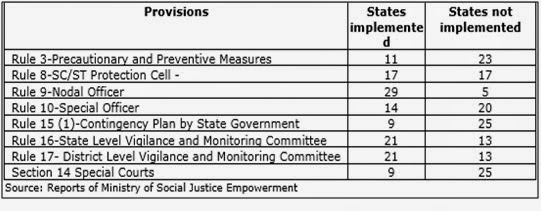
According to the data of Ministry of Social Justice and Empowerment, majority of states do not fulfill minimum statutory provisions as per the Act, 1989 and Rules, 1995. Following table shows the status of non-implementation of the provisions of SCs and STs (PoA) Act, 1989 and Rules 1995 by State Governments. 


Although there is provision in the PoA Act for the constitution of Special Courts to expeditiously try atrocity cases, in reality what SCs/STs experience is a huge pendency of their cases before the trial courts. Moreover, the conviction rate is very low. In fact, the conviction rate under the PoA Act is found to be much lower than in cases booked under IPC. According to the NCRB data, in 2013 the average conviction rate for crimes against Scheduled Castes and Scheduled Tribes stood at 23.8% and 16.4% respectively as compared to overall conviction rate of 40.2% relating to IPC cases and 90.9% relating to SLL (Special and Local Law) cases. The processing of reported cases for investigation and trail is very slow.  According to the NCRB data, 35645 cases are pending in different courts for trial. Large numbers of cases are pending in States such as Uttar Pradesh, Bihar, Odisha, Gujarat and Karnataka.

The National Advisory Council (NAC) during UPA government reviewed the provisions of law and cases of atrocities and found that certain forms of atrocities, though well documented, are not covered by the Act. NAC recommended for the incorporation of various IPC offences and other commonly committed offences under the perview of this law to ensure wider protection to the victims of caste atrocities. The National Commission for Scheduled Castes (NCSC) and Justice Punnaiah Commission critically examined deficiencies of the Act and has suggested various amendments to the Act. Human rights organizations have also highlighted various gaps in the enforcement of the Act and Rules. Ministry of Social Justice and Empowerment and Ministry of Home Affairs have issued various advisories to State governments to fill the gaps in the enforcement.

Status of Atrocities:

The National Crime Record Bureau (NCRB) data further exposes the poor implementation of the Act and its minimal impact in effectively dealing with caste based atrocities. The data reveals that the number and frequency of crime against SCs and STs are continuously increasing. The prevalent atrocities against SCs and STs includes incidents such as making SCs eat human excreta, and subjecting both SCs and STs to physical assaults, grievous hurt, arson, mass killings and rapes of SC/ST women, etc. Although the National Crime Records Bureau (NCRB) provides useful data that reveal the extent of atrocities committed against the SCs/STs, these data do not fully reflect the ground reality as most of the cases go unreported due to reluctance by police to register atrocity cases for various reasons. One also finds caste bias and corruption among the police force preventing registration and investigation of cases.

Even after low rate of reporting of crime under PoA Act, incidences of crime under this Act has increased from 11602 incidences in 2008 to 13975 incidences in 2013. The incidences of rape have shockingly increased from 1457 in 2008 to 2073 in 2013 (an increase of 42.27%).  There has been no mitigation with annual average of crimes registered against SCs/ST standing at 39408 and daily average being 108.

Proposed Amendments in PoA Act, 1989:

The literature and empirical data on caste atrocities reveals that it made nominal impact in the lives of SCs and STs. However, various assessment of the law reveals that it has created a sense of security and protection among the victims of the caste atrocity. Dalit and Adivasi victims have used it as a tool to assert their basic rights and combat with wrong social and cultural practices. The current situation of atrocities and status of cases pending in police station and in courts led stakeholder to advocate for amendment in the PoA Act, 1989.

The Scheduled Castes and The Scheduled Tribes (Prevention of Atrocities) Amendment Bill, 2014 introduced in the Lok Sabha on July 16, 2014 that replaces ordinance enacted by UPA government in March 2014 represents the consensus  of stakeholders to amend the law for better results.

The amendment Bill proposes substantial changes in the chapter on ‘Offences of Atrocities’ (Chapter-II) of the Principal Act. The proposed amendments attempts to increase number of IPC offences under the preview of this act. It also recognizes commonly practiced action in society to insult and harm dignity of person from SC and ST community as an offence. These offences are garlanding with footwear, compelling to dispose or carry human or animal carcasses, manual scavenging, attempting to promote feeling of ill-will against SCs or STs, imposing or threatening a social or economic boycott. The amendments in this chapter further specify duties of public servant in detail and prescribe punishment in case of any neglect of duty by the public servant. The common duties of public servant includes registration of FIR, furnishing a copy of information recorded by the informant in police station, to record statements of victims or witnesses, conduct investigation, file charge sheet within six days and keep records of document.

Addressing issue of long pendency of cases and low conviction rate under the Act, the amendment Bill proposes constitution of Exclusive Special Court and Special Courts to dispose cases within given time-frame. The provision in the bill ensures adequate number of courts so that every case can be disposed within the period of two months from the date of filling of the charge sheet.  The bill has inserted a new chapter namely ‘Chapter IVA’ in the principal Act, that describes the rights of victims and witnesses in detail. Some of the crucial rights of victims and witnesses are as follows:

·   Right of victims, their dependents and witnesses to access state’s support for their protection against any kind of violence, threats, coercion, inducement and intimidation. 
·   Right of victims to access special support from government, that arises because of their age, gender, educational disadvantage and poverty.
·  Right of hearing views of victims at any proceeding under this Act in respect of bail, discharge, release, parole, conviction or sentence of an accused.
·  Right of victims, their dependents, informants and witnesses to access facilities of relocation, rehabilitation and maintenance during investigation, inquiry and trail of the case.
·  Right to access information about trial, enquiry and trial such as recorded FIR and provision of laws and allied schemes of relief for victims, their relatives.
·     Right to access relief in cash or kind.
·    Right of atrocity victims and their dependents to take assistance from Non-Government Organizations, social workers and advocates.

Soon after the introduction of the amendment Bill in the Parliament, the Lok Sabha Speaker referred the Bill to the Parliamentary standing committee for further deliberation.

Conclusion:

The Scheduled Castes and the Scheduled Tribes (Prevention of Atrocities) Amendment Bill, 2014 introduced in budget session 2014-15 replaces ordinance brought in by UPA-II government in March 2014. The proposed amendments in the principal act comprehensively addresses issues of non-implementation, in-effectiveness and number of loopholes in the existing law as highlighted by various human rights organizations, Dalit activists and public institutions. The amendments in the Act will ensure wider protection and timely justice to the victims of caste atrocities. It has already been delayed for so many reasons, but now it is up to the Parliament and political parties to understand the urgency of the amendment Bill to provide relief to the SCs and STs who constitute almost one forth of Indian population.
 
Jeet Singh
 

Monday, 13 October 2014

Forest Rights Act and Land Ownership in India


Source: the Hindu
Introduction and Brief Background
Forests in India house over 250 million people whose home, hearth and livelihood comes from their forest dwellings for generations. However, forest dwellers in India are among the most marginalized and neglected sections of the society comprising primarily of tribal and Dalit communities whose livelihood depends on the forest produce of the land that they have used for centuries.

During the colonial era, the draconian Indian Forests Act (IFA) was enacted in 1927 divided the forest into the Reserved (no human activity allowed) and Protected (controlled human activity allowed) categories. Some felling was allowed in the latter category, but cultivation and livestock grazing were banned in both. This destroyed the traditional way of life.

The abolition of the Zamindari system exacerbated the situation as more common lands were nationalized and converted into protected forests. This was later amended and the traditional occupants were given titles based on the length of occupancy. This, however, gave disproportionate power to the Patwaris (keeper of land records), and given the non-existence of ownership records corruption became rampant. The FRA sought to rectify this by providing a clear, transparent and environmentally friendly procedure for the resettlement of the people and displaced wildlife.
However, the act is not serving the purpose with which it was enacted. Where is the implementation lagging behind? Would the current government keep up the Centre’s commitment of equality in land ownership notwithstanding the differences political ideology with the previous UPA government? What exactly is the FRA? These are some of the issues examined in this essay.

The Scheduled Tribes and Other Traditional Forest Dwellers (Recognition of Forest Rights) Act, 2006

The Scheduled Tribes and Other Traditional Forest Dwellers (Recognition of Forest Rights) Act, 2006 (FRA) was enacted in 2006 to address the sever shortcomings of the 1927 act. The IFA resulted in the alienation of tribals and other forest dwellers. It is an act which protects the land ownership titles in the tribal belt of India and had been demanded for long to safeguard the interests of the most marginalized people of the country. However, the implementation record (including guaranteed land holdings under the act) has been poor.

Discrepancies in tribal forest land allocation and redistribution has also been at the centre of India’s Left Wing insurgency in what is called the Red Corridor. Therefore, he 2006 act’s importance multiplies in not only addressing the injustice done to the traditional forest dwellers over centuries, but also as a means to combat what has been called India’s worst national security crisis.

The 2006 act was radically democratic in many ways as it acknowledged the historical injustices done to the forest dwelling communities and set a forward-looking path to correct those. There are twelve types of rights enlisted in the 2006 act to undo the damage that has already been done and these include rights to land occupation, forest produce, both timber and non-timber, management of community forests and home and hearth. It also empowers and makes accountable the traditional forest dwellers to protect the biodiversity, water resources and other resources of the forest as well as catchment areas and seeks to establish a community based forest administration in the country with the Gram Sabhas at the helm of affairs. The land ownership titles will be ascertained to the maximum limit of 4 ha per person by a committee comprising the District Collector, the Divisional Forest Officer and the Superintendent of Police.

There are many misconceptions surrounding the act for which it has come under criticism. Many people believe that the FRA is meant to redistribute land up to a maximum ceiling of 4 hectares per person. However, the truth is that this act is not a land redistribution act and does not empower anyone to do so. On the issue of land, the FRA requires the state and central government to legally recognise the lands as revenue lands on which forest dwellers have been carrying out farming prior to 13 December 2005.

For non-Scheduled Tribes (STs), this recognition comes after proving that they have been farming on the land in question for the past 75 years. As per the FRA, the traditional forest dwellers and STs will only receive rights to ‘land under their occupation’ and no more, for the time specified up to a maximum of 4 hectares per person. Any claims over the stipulated 4 hectares will not be entertained. No new land distribution will take place and the titles given as per the act cannot be sold or transferred, except through family hierarchy. It is not a welfare scheme and deals with defining the forest land and its occupation.

In 2012, then Minister for Tribal Affairs, Mr. Kishore Chand Deo had written a letter to the CM’s of states, urging them to implement the act properly. However, despite all the efforts by the previous government and civil society activists, the implementation record of the act has remained poor. Moreover, widespread corruption which still exists in the process of implementation has hindered the powers of the act substantially. 

Critics of the FRA say it was enacted by the government for privatizing natural resources and making vote banks out of the forest dwellers. But the basic principles of the act were largely misinterpreted and contorted based on state-wise implementation record.

Conclusion

The enactment of the 2006 FRA is an example of inclusive, democratic and enabling legislation which came in a favorable pro-poor political environment. However, the implementation rests with local authorities and state governments where the failure is stark. According to Ministry of Tribal Affairs’ report from January 2014, 36, 54,420 claims have been filed and 14, 18,078 titles have been distributed. Further, 15,864 titles were ready for distribution. A total of 31, 06,690 claims have been disposed of (85.01%). Unfortunately, there are no records of details of the amount of land under each title. Whether these gains for the forest dwellers are consolidated in forms of actual substantive rights and access remains an open question. There is also no readily available record of uses for such land. Various non-government report states that this number is grossly inflated and titles to a full authorized 4 ha per person are rare in all the states.

There are also several cases on encroachment still pending in the courts of different states wherein, lack of proof of occupation has led to a traditional forest dweller to be incarcerated as a squatter.

The role of Gram Sabhas has also not been exemplified under the act yet on ground. Moreover, mining activities on traditional forest land in some of the states by corporate houses is still going unnoticed. 

In spirit, this act is phenomenal but the leakages in implementation reduce it to the status of just another act which is supposed to work but isn’t.   

The current government needs to look beyond political differences and keenly push for a better implementation of the FRA under due process. This is one of the landmark legislations which follow the democratic principles enshrined by our founding fathers in our constitution. 


Medha Chaturvedi